EFCA Theology Conference Session 7

The Theology of Sexuality Applied: Teaching/Training of Youth in the Home and the Church – Stan Jones

What are our Objectives in Sex Education and in Parenting?

To prevent immorality?

To equip and empower our children to enter adulthood capable of living godly, wholesome lives

Don’t focus too narrowly and negatively, such as focusing on only preventing sexual immorality and the ravages that illicit and irresponsible sex; this goal is too small, too limited, too narrow. Our most important goal in sex education should be to equip and empower our children to enter adulthood capable of living godly, wholesome, and fulfilled lives as Christen men and women, Christian singles, wives and husbands.

Deuteronomy 6:1-9

A Summary of Key Points in the Theology of Sexuality

We are embodied, we are gendered sexual beings, we are relational, we are made in God’s image, we are broken and twisted, we encounter objective reality when we have sex, we are souls under construction

We are souls under construction

Given/Discovered Constructed?

Given: Evolutionary Psychology Reproduction as an evolutionary impulse in the context of a meaningless universe; sex, like life, is meaningless

Atheist Delusions (David Hart)

The Five-Factor Model of Sexual Character:

Needs – Relatedness and Significance

Values

Beliefs

Skills

Supports

Twelve Principles of Christian Sex Education in the Family and Church

Principle 1: Sex education is the shaping of character

Principle 2: Parents are the principle sex educators

Principle 3: First messages are the most important

Principle 4: Seize those “teachable moments;” become an “askable” parent

Principle 5: Stories are powerful teaching tools

Principle 6: Accurate and explicit messages are best

Principle 7: Positive messages are powerful

Principle 8: “Inoculate” your children against negative beliefs

Principle 9: Repetition is critical; repetition is really, really important

Principle 10: Close, positive parent-child relationships are crucial

Principle 11: Sexuality is not everything; keep your perspective

Principle 12: Our God can forgive, heal, and redeem anything

EFCA Theology Conference Session 5

The Witness of Paul: Apostle to the Gentiles – Robert Gagnon

Romans 1:24-27, 1 Corinthians 6:9, 1 Timothy 1:10

Romans 1:24-27: Opposed to some, or all, forms of same-sex intercourse?

Three main arguments made to discount Romans 1:24-27

  1. The exploitation argument: Paul only knew of exploitative forms of homosexual practice in his culture
  2. The orientation argument: Paul had no concept of a homosexual orientation
  3. The misogyny argument: Paul feared homosexual practice would upset male dominance over women

The plot structure of Romans 1:18-32

Stage 1. God’s power and divinity is manifested in creation

Stage 2. Humans suppress the truth and foolishly exchange

Stage 3. God’s wrath is manifested in giving over humans to self-degrading desires

Stage 4. These sinful deeds merit death

Intertextual echoes to Genesis 1:26-27

References to creation and Creator

Rom 1:23 echoes Genesis 1:26

Romans 1:26-27 echoes Genesis 1:27

The point of these echoes – idolatry and same-sex intercourse together constitute a frontal assault on the work of the Creator in nature, those who suppressed the truth about God visible in creation they went on to suppress the truth about themselves visible in nature

The argument from nature

The truth about God is visible and apparent in material creation (1:19-20)

The truth about God’s will for sex is visible in our gendered bodies (26-27)

Pagans do not have to have Genesis or Leviticus to be held accountable for this knowledge, they are “without excuse”

Innate desires are unreliable guides

The mention of lesbian intercourse in Romans 1:26

The mention of mutual gratification in Romans 1:27

The conception and practice of caring homosexual relationships in antiquity

Absolute nature arguments in the Greco-Roman world

Why Paul is not saying, “Don’t judge homosexual practice”

The one whom you obey, that it your Lord. Don’t say with your mouth that you follow God but then continue to serve sin, that is your Lord

What even scholars supportive of homosexual unions admit

1 Corinthians 6:9 (& 1 Tim 1:10) Opposed to some, or all, forms of male-male intercourse?

Meaning of malakoi “soft men”

Meaning of arsenokoitai “Men who lie with a male”

The Bible’s alleged ignorance of sexual orientation

Grego-Roman theories of a congenital basis for some homoerotic attraction

Differences with contemporary theories and beside this point

Did Paul get “nature” confused?

What even scholars supportive of homosexual unions affirm

The Bible’s Alleged Misogynistic Bias against Homoerotic Unions

Ignoring concerns for structural complementarity in ancient texts

Absoluteness of Bible’s prohibition suggest priority of gender over status

Women’s liberation as a stimulus for opposing all male homosexual unions

An absurd corollary

View of women in the Bible fares well relative to its cultural environment

EFCA Theology Conference – Session 4

A Theology of Human Sexuality – Ben Mitchell

A Few Caveats

Our anthropology requires charity

Our language anticipates double entendres

Our calling demands compassion

Our experience requires humility

Our task calls for courage

Our responsibility requires us to contextualize the question

Why so Important?

The order that God has given us (Gen 2:24-25)

Paul says sexual immorality is not even to be mentioned among those in the Christian church (Ephesians 5:3)

Why Such a Difficult Subject?

A confused culture in which our paradigms have shifted radically

A marginalized church

A challenged Bible – both from the outside and the inside

47% of people who say marriage is becoming obsolete still want to be married

Sexual Morality: Creation

Human sex and sexuality are important, powerful and good aspects of God’s creation (Gen 2:15-25 – bonding, procreation, Proverbs 5:15-20 – pleasure, fidelity)

They don’t cease to be man or woman but their flesh is joined in such a way that we call them one flesh

Stanley Grenz Sexual Ethics

There are only two ways to be human, as male or female, at its core is a fundamental incompleteness

Goods of sex and marriage

Procreational good – Gen 1:28; 9:1

Relational good – “humanity which is not fellow-humanity is inhumanity” Barth, CD

Public good – ordered and regulated relationships in human society

Marriage

The relational purpose of marriage (Gen 2:24 – one flesh, sexual and non-sexual companionship, giving of one’s person to another)

Pornography

There is a casual connection between words or pictures and human behavior

“Shame” is part of the natural human condition. It is counterpart of natural human modesty

The political purpose or result of pornography is to make us shameless

There is a connection between shame and self-restrained and therefore a connection between shame and self-government or democracy

Self-restraint is necessary to the moral and political well-being of the community

Pornography threatens self-restraint and then threatens democracy

Conclusion: therefore, government has at least a modest interest in censoring pornography (as a protection of democracy)

By Walter Evans “Beyond the Garbage Pale”

Sexual Morality: After the Fall

Sexuality and sex are disordered

Sex is to be expressed according to God’s instruction: not outside the covenant of marriage (Heb 13:4), sexual lust is forbidden (Matt 5:27-30)

Sex

Not the most important thing in the world!

1 Corinthians 7:1-5

Marriage

The healing purpose of marriage (1 Cor 7:9)

“Marriage functions to provide needed restraint and discipline as the God-given place of healing for our sexual nature” – Gilbert Meilaender

Celibacy or singleness

Vocation?

Pathology?

Gift parallel with marriage? (1 Cor 7:7, 32-35, Adam and Eve were married, Jesus was single)

Pastoral issues: identity and self-worth, solitude and loneliness, sexuality and celibacy – see C.S. Lewis Four Loves specifically his chapter on friendship

Cohabitation

According to sociologist Patricia Morgan, cohabitation relationships are fragile

Cohabiting couple accumulate less wealth than married couples

Cohabiting women are more likely to be abused

Cohabitants have more health problems than married couples

Children of cohabiting couples often suffer

Cohabitation: the biblical witness

Creation-only appropriate expression of sexual intimacy is the bond of marriage

Singleness is an inappropriate context for the sex act “One flesh” is reserved for married couples

No permission for cohabitation in scripture

Marriage and the marriage bed are held up as honorable

Homosexuality

Helmut Thielicke Theological Ethics vol 3, Sex, p. 271

Sexuality: Redemmed and Celebrated

1 Timothy 4:1-5

“Salvation by God’s grace through faith in Christ is not redemption from sexuality, sex or our sexual impulses. It is rather redemption within our created sexuality, necessitated by distortions of the Fall”

God’s Will for Today – 1 Thessalonians 4:3-8

EFCA Theology Conference Session 3 – Robert Gagnon

Jesus and Marriage – Robert Gagnon

Key Jesus Sex Text: Mark 10:2-12 (parallel is Matthew 19:3-9)

Learning from Jesus: A Back-to-Creation Model

  • Jesus declared Gen 1:27 and 2:24 to be the model for marriage
  • For Jesus, marriage isn’t something for humans to tinker with
  • Jesus emphasizes the “twoness” of a sexual bond
  • Prohibits both a revolving door of divorce/remarriage, implicitly polygamy
  • Where does Jesus get this number “two”
  • Gen 1:27, Gen 2:24, what do these 2 verses share in common: the union consists of a man and a women. Two sexes designed by God for a sexual union.
  • Twoness of the sexes is the foundation for the twoness of the sexual bond
  • Confirmation: Qumran’s basis for rejecting polygamy
  • S the twoness of the sexes is the basis for the twoness of the sexual bond

Three Corollaries to Jesus’ Back to Creation Model

  1. OT Law does not always reflect God’s perfect will
  • Many people think Jesus is increasing the permissions of marriage, Jesus is doing the opposite and actually making it more rigid
  • Jesus unilaterally amended the constitution of Israel
  • Moses made a concession to male “hardness of heart”
  • Jesus worked toward a more rigorous sexual ethic, closing off remaining loopholes
  1. Jesus repudiated inequities toward women, but in which direction?
  • In early Judaism, a man could commit adultery only against another woman’s husband
  • What Jesus did not do is give women the same sexual license that men had
  • Instead, he bound men to the same high standard as women
  1. A homosexual relationship is worse than a polygamous one
  • Jesus regarded a male-female prerequisite as foundational for sexual ethics
  • That obviously precludes a homosexual relationship

Further evidence of Jesus’ rejection of Homosexual Practice

  1. Nine other arguments
  • Jesus’ retention of the Law of Moses (Scripture) generally
  • Jesus’ intensification of the Law’s sex ethic (adultery of the heart, divorce)
  • John the Baptist’s strong stance on sex laws
  • Early Judaism united opposition
  • The early church’s united opposition
  • Jesus saying about the defiling effect of desires for porneia (Mark 7:21-23)
  • Jesus on the Decalogue adultery prohibition (Mark 10:17-22)
  • Jesus’ saying about Sodom (Matt 10:14-15; Luke 10:10-12)
  • The “born eunuchs” statement (Matt 19:10-12)
  1. Why then did Jesus not speak directly against homosexual practice?
  • No need to, the Hebrew Scriptures already clearly established man-male intercourse as a grave offense
  • No Jew is known to have engaged in homosexual practice in the period, it wasn’t happening. It would have been a waste of Jesus’ time
  • What then is the meaning of Jesus’ silence on homosexual practice? Same thing as his silence on bestiality

Jesus on Divorce and Remarriage

  1. Prohibiting remarriage after divorce
  • Matt 5:32, Luke 16:18, Mark 10:11-12, 1 Corinthians 7:10-11
  • If a man divorces his wife on invalid grounds would mean that the marriage is still intact in God’s eyes, so if the man remarries he is committing adultery by having sex with a woman other than his wife
  1. The hardest case: A woman invalidly divorced
  • She’s the victim of a divorce, yet if she remarries she is committing adultery, again the main part is if the marriage is still intact

Learning from Jesus: Other Principles

  1. Sex ethic distinct from love command
  • If these are the same, if we truly loved everyone we should be having sex with everyone. Jesus said to love everyone, but have sex with only 1 person
  1. A strong interior component to sexual ethics
  • He wants not only external but internal obedience
  1. Sexual ethics as a life-and-death matter (Matt 5:29-30, John 8:3-11)
  2. A heightened ethical demand coupled with a loving outreach to violators
  • Jesus is asking us to do both
  • The parallel of tax collectors and sexual sinners – Jesus reached out to both of these groups – outreach to those in greatest danger
  1. Jesus on the love commandment, rebuke and forgiveness, the Good Samaritan
  • Love your neighbor as yourself, a true understanding of love is not about you, it’s about correcting a friend who is straying
  • Rebuking and forgiveness Luke 17:3-4
  1. The ends of marriage
  • Procreation (Gen 1:27-28)
  • Companionship and sexual enjoyment (Gen 2:18_
  • The highest objective of marriage is not even companionship, but Jesus’ insistence on marital indissolubility, based on the 2 becoming 1, is the key
  • Marriage is God’s instrument for reuniting male and female into an integrated sexual whole
  • God designed marriage for shaping two into one
  • Sexual activity sets in motion a reality beyond the individual’s control

EFCA Theology Conference 2013 Session 1, Ben Mitchell

Human Sexuality – The Cultural and Ecclesiological Landscape – Dr. Ben Mitchell

A Few Caveats

  • Our anthropology requires charity
  • Our language anticipates double entendres
  • Our calling demands compassion
  • Our experience requires humility
  • Our task calls for courage
  • Our responsibility requires us to contextualize the question

Traditional Teaching on Sexuality and Marriage

  • One should refrain from sexual activity until marriage (i.e. the wedding)
  • An essential and normal (thought not the only) purpose of marriage is to produce marriage
  • One should refrain from sexual activity with anyone but one’s spouse
  • One should choose a spouse from the opposite sex
  • The marital estate is intended to be a permanent love relationship

All of these planks are being challenged today, and has happened within the past 60 years – a short period of time.

Today – many things within the scheme of sexuality are problematic

  • Courtship is dying
  • Cohabitation is growing
  • Marriage is disintegrating
  • Pornography is pandemic
  • Sexual abuse by clergy in daily news
  • “Adult toys” industry is mainstream
  • Shades of Grey popularizes “mommy porn”
  • Promiscuous procreation – there are 38 ways to make a baby
  • De-population is becoming problematic – especially in Europe
  • No-fault divorce is rampant
  • Children are suffering
  • Polyamory is becoming increasingly acceptable

How did we get here?

  • A cultural revolution took place
  • A cultural revolution, whatever the political ambitions of its architects, result first of all in metamorphosis in values and the conduct of life (see The Long March)
  • Both drugs and sexual liberation are expressions of the narcissistic hedonism that was an important ingredient of the counterculture from its development in the 1950s. The culture at large has taken the adolescent virtues and values from the sixties.
  • See Souls in Transition by Christian Smith sociologist believer at Notre Dame: Emerging adults are: soft ontological anti-realists, epistemological skeptics and perspectivalists. They believe that what’s good for you is good for you, but may not be good for me, it’s all up to personal preference.
  • “When young people want to praise themselves, they describe themselves as ‘non-judgmental.’ For them, the highest form of morality is amorality.” From Our Culture. What’s Left of It

The Great Divide – between conjugal marriage view and revisionist marriage view

  • The revolution has been nearly completed, President Obama has supported same-sex marriage

The Main View of Marriage within Evangelical Christianity

The Cultural Context/Accomadationist Approach

  • Jack Rogers, author of Slaves, Women & Homosexual
  • Overall idea: what the Bible is speaking against is a completely different context, very different than the monogamous homosexual relationships we are supposed to embrace today so we need to accommodate the culture.
  • Yes, we need to contextualize the text, but the biblical writers knew and what the Bible repudiates is very, very close and in some case identical to what we are being asked to accept and legitimize in our culture.

Natural Law-Consequentialist Approach

  • The Case for Marriage and What Is Marriage? Books
  • Marriage is the foundation for human civilization, if you can’t embrace that you can’t embrace true marriage. BUT there are also negative consequences for not embracing this view of marriage – looking at cohabitation, effects of dissolution of marriage on a culture, how it affects children, etc.

Separationist/Let’s Get On With It Approach

  • We’ve already lost the battle for traditional marriage, we are alienating the people we want to reach with the Gospel, so let’s back away from the public debate and entrench ourselves in the churches, protecting marriage there, letting us evangelize those we haven’t yet alienated.

Prophetic/Pastoral Witness Approach

  • We cannot give away marriage, we have to do all we can to preserve traditional marriage within the church, but also do all we can in appropriate ways to defend our ideas in the public square just like the prophets called out the sins of the people of God and the judgment of those who do not believe, in an attempt to show people the truth of Scripture. (Matthew 19:4-6)

EFCA Theology Conference 2013

Today I will be traveling down to Denver for the 2013 EFCA Theology Conference on the topic of Human Sexuality. The denomination always tries to do hot topic issues that are going on in the culture and this year is sexuality. I’ll be doing my best to live blog the speakers as they finish for those who are not able to go to the conference themselves. I’m very much looking forward to hearing all these issues and as always, I love being able to connect with other pastors in the free church. Be praying as it begins today at 1:10 Mountain Time – a couple of the speakers have already had to cancel their trip out to Denver with health issues, thankfully they’ll be able to Skype in.

Preaching From an iPad Part 2 – How To

One of my friends asked me to show him how to set up your sermon on an iPad so here is a guide for how to set up your sermon from Word to ultimately working in iBooks on your iPad.
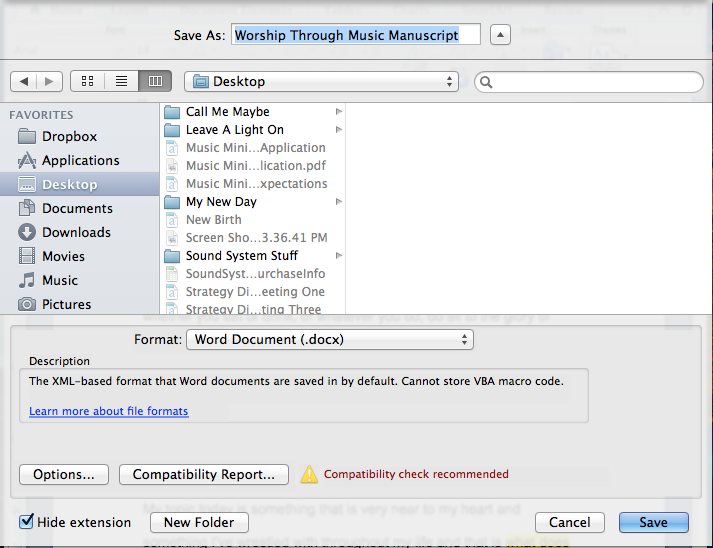
The first thing you need to do is actually write your sermon! I use Microsoft Word for all my typing. I’ve tried using Pages and NeoOffice and just found Word to be the easiest and most versatile. Once you’re done and ready to send it to the iPad you need to save it so you’d click File -> Save As

1That will take you to this screen:

2

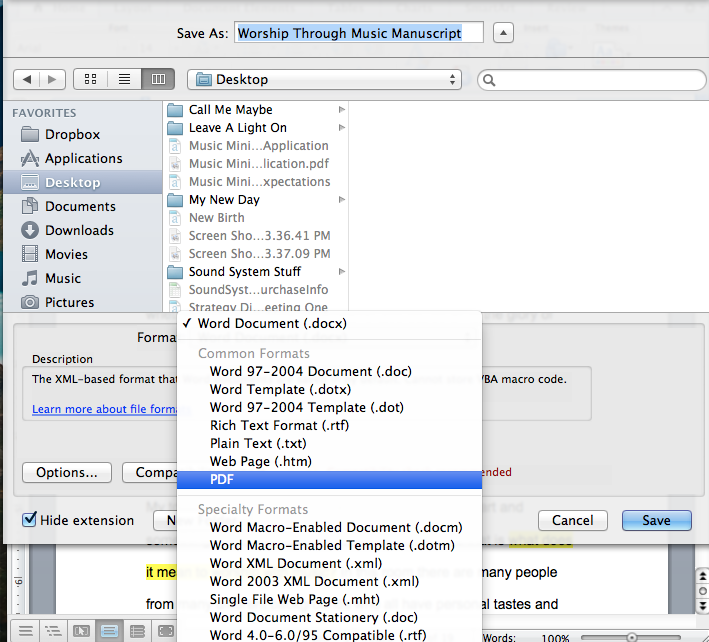
Name it whatever you want to name it, and make sure you save it to a place you can easily find. I always save it to my desktop. Then click in the Format box.

3Change the format to PDF, then click Save. Now is when it’s important to remember where you saved it! E-mail it to yourself as at attachment to the e-mail you can access on your iPad. I typically use this e-mail as a chance for some encouragement! Open the e-mail on your iPad and it should look like this:

4Click on the attachment to download the file, it will open in a new window like this:

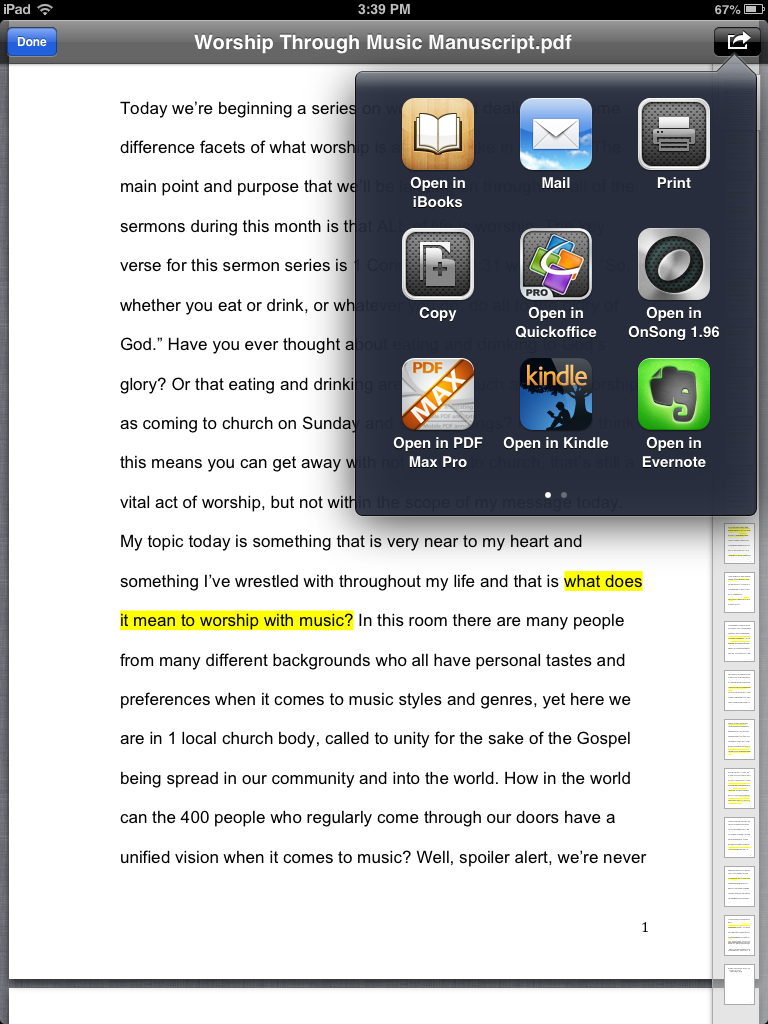
5Once you have that open, click the arrow in the top right corner which will give you a list of available apps to open the file with.

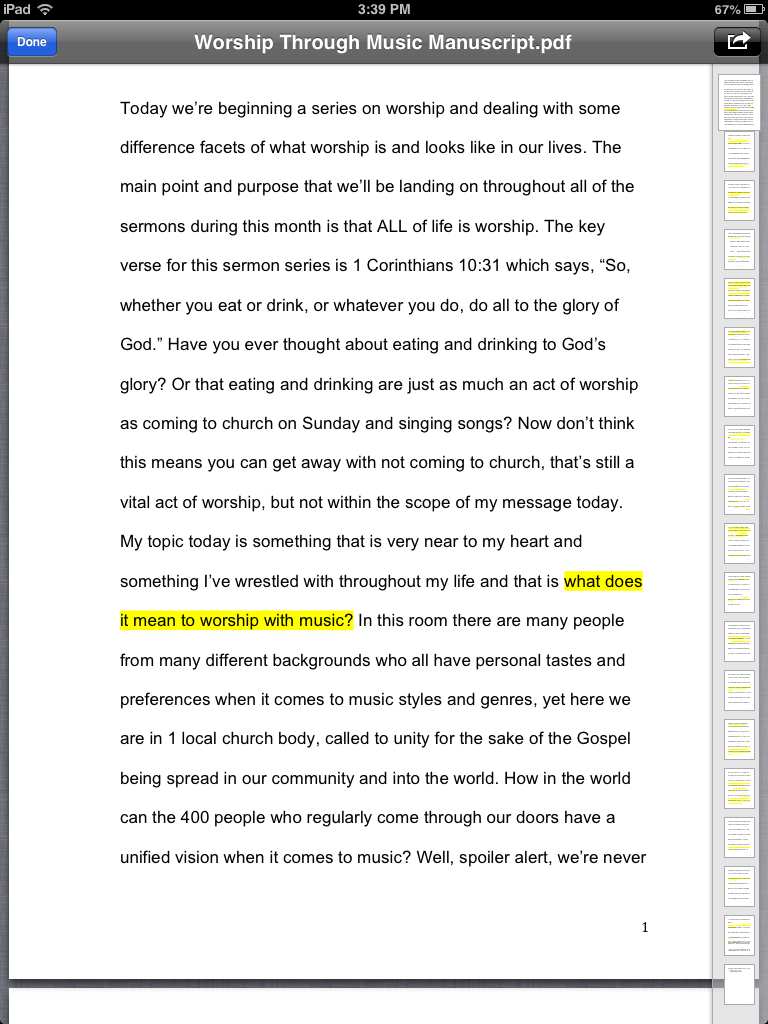
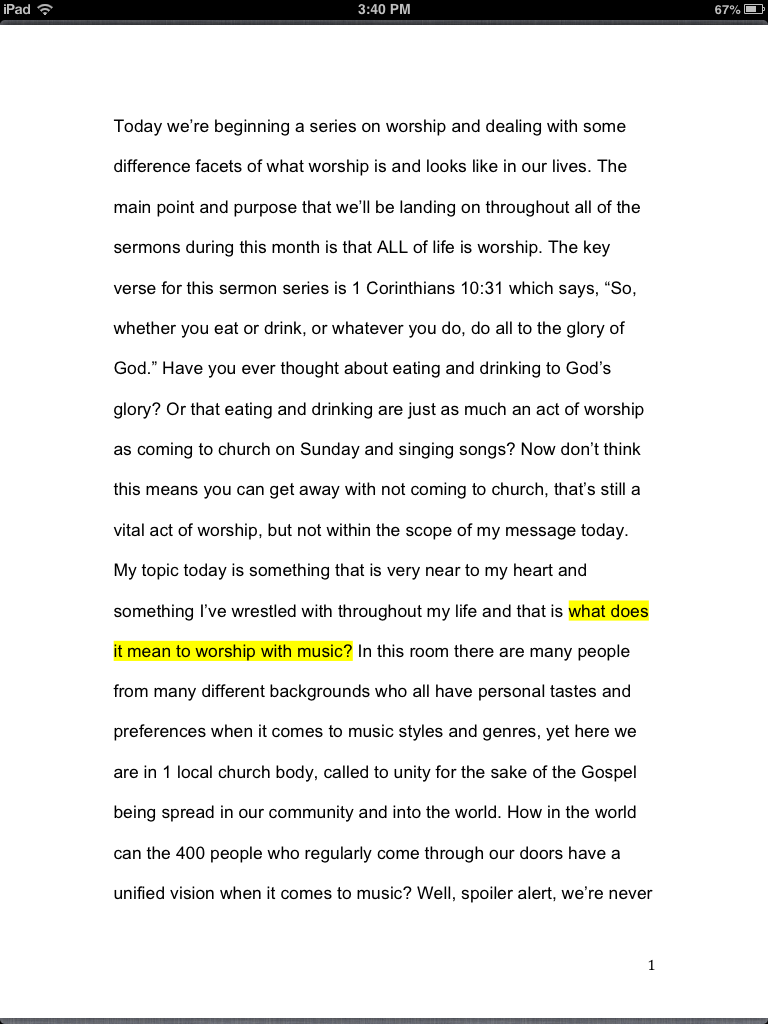
6Click ‘Open in iBooks’ and it may take a little bit to load depending on the size of your sermon, but you’ll finally have your sermon on your iPad looking like this:

7One of the best things about this is you can also see what time it is and how quickly you need to wrap up your sermon! A couple thing to remember about this is typically people have their display set to go to sleep after a couple minutes. I shut mine off for this. I also turned the brightness up all the way and made sure there weren’t any lights behind me that put a bad glare on the screen. I found this very easy to use and preach from without having to shuffle through what would have been 18 pages. My iPad has a smart cover on it too which has magnets in it so when I placed it on the music stand to preach from the smart cover held it in place really well. Feel free to ask me any questions about putting your sermons on your iPad!


Preaching From an iPad

One of the things I really enjoy is technology. I love learning how to use new technological advances to make my life easier and find ways to do the things I am doing better. I love finding new recipes on Pinterest, following people on Twitter and staying in touch with friends on Facebook. This past week for the first time, I used my iPad to preach, and I loved it! I thought it was much easier than trying to shuffle through paper, and having my Bible app easily accessible was great! We also have almost our whole Sunday service automated so I can control the background music, the slides and the sound board now all through my iPad. We’ve been using a newer presentation program Proclaim for all our services and I’ve found it great to use!

So this past week I wrote out my manuscript and tried to stick to it very carefully as I was dealing with a weighty issue (worship through music). I had it all typed in Word and highlighted the main points I needed to remember, then exported it as a pdf and then preached from it using the iBooks app that apple makes. It was incredible easy. All I had to do was tap on the right side of the screen and the next screen would pop up. If you have an iPad, I highly recommend using it to preach. I even have all my music in it so I lead music for church on my iPad. It really amazes me how easy it is to use and have everything I need in one centralized location.

Worship Through Music

I was given the opportunity to preach this past week and began a series on worship, looking specifically at worship through music. My main text was Ephesians 5:19-21 and ended with this point:

“This leads us to the final point from this Ephesians 5 passage “submitting to one another out of reverence for Christ” Brothers and sisters this continues to be one of the biggest issues in our church today. That first word, submit is something that is not attractive to our generation at all! Everyone wants to be in control of everything they do instead of being accountable to someone. We have convinced ourselves that we can be our own little gods who sit on our own little thrones and control our own destiny. Yet reading through Job we see just how small and insignificant we truly are. We come to church, not to encourage or support each other, but to get what we can from the church. We just looked at why we come together to sing corporate songs of worship together, it’s not for our sake, it’s for God’s sake!

One of the most disheartening things for me about where we are now is that before we sing every song I can look out at you and know who’s going to refuse to sing this specific song because it’s not one you like. Once again, I hate to be the bad guy, but it’s not about you. This is the very reason we had the “worship wars” during the past couple decades, too many have refused to submit to one another and have chosen instead to focus on themselves, their wants and their desires. Believe it or not there’s even some songs we do that I don’t like at all! Wait, you might say, you get to pick the songs. That’s exactly my point! Would you like it if every time we sang a song that I don’t really like I put down my guitar and refused to sing? Besides not keeping my job here very long, that would take the focus off of God and onto myself.”

You can listen to the message in its entirety here.

Children’s Bible Reading

Sorry I’ve been gone for a while! December was a crazy month.

I found a fantastic guide today for children’s Bible readings here. This is something I was always told to do growing up, and even saw it modeling in my parents but wasn’t exactly sure how to go about it. This breaks the Bible down into very manageable portions (just a few verses at a time) and then asks a specific question about the text and includes room for prayer items. This would be a great way to give kids opportunities to practice writing as well!