Psalm 42-43 – Sermon Manuscript

-One of the realities of living “east of Eden” as Steinbeck so famously put it is that life is difficult, isn’t it? And the older you get, the more complex things seems to become where then you laugh at the things you couldn’t handle in your youth! I remember as a music pastor, being told from a high schooler that life was getting too busy so they needed to step off the music team. They did no extra-curriculars and didn’t have a job, so I was confused about how “full” their life was! But that’s looking at it from a 25 year old’s perspective instead of a 15-year-old (my prefrontal cortex was fully developed!)

-Have you ever heard the quote “Life is hard, then you die” before? I looked it up this week, turns out it’s from a science fiction writer (who contributed to Star Trek), but there’s also more to the quote:

-But for those of us who are in Christ, that’s not the end of the story is it? Life may be hard, but there’s always reasons to hope: God is always in control and never leaves us to struggle on our own. But that first sentence remains true, doesn’t it? Life IS hard! That’s a universal reality. The question for anyone is what do you do when life is hard? Today’s passages help us understand what to do when life is hard: we cry out to God.

-We’re beginning book 2 of the Psalms today (broken into 5 books as a picture of the Torah), which contains a number of Psalms written by “the sons of Korah” we’ll get to them in a bit, but we’re going to be looking at Psalms 42-43 today because they appear to have originally been combined into 1 Psalm. There’s a repeated refrain that appears in both that gives us the outline to this Psalm.

READ/PRAY (pg. 494)

  1. Thirsting for God (1-5)

-Who are the sons of Korah? According to 1 Chron. 6, these are part of the guys who served under David as the music leaders in the Lord’s temple. If you’ve ever wondered why we do so much singing at church, it’s because God’s people have always been a singing people. The biggest book in the Bible (Psalms) is a book of songs, there were music leaders in the tabernacle, Jesus sang with His disciples, and Revelation tells us that there’s singing around the throne 24/7 today. So when we gather each week to sing, we’re joining in to something that’s already taking place in the spiritual realm, but we have the privilege of joining along.

-As a deer pants for flowing streams. Once again, we need to know our Psalms! This is alluding back to Psalm 1:3 where the righteous person is the one who is planted beside a flowing stream. And do you see the contrast between what Psalm 1 says vs. what we just read about from these Psalms? Here the Psalmist isn’t enjoying a happy season, he’s feeling a distance from the Lord.

-Some scholars believe this Psalm was written by David, but adopted by the sons of Korah, and then tweaked by them. Just like a song today might be written by multiple people. It’s an individual lament that contains references to the corporate gathering, even here the gathering is alluded to: appear before God isn’t done by yourself, it’s done in community. But think of this thirst being described.

-Have you ever been so thirsty you would do anything for just another drop of water? A couple years ago I got to go on a little 110 mile hike with some other pastors from MN across the Alps (which forever means I have that soft flex to throw out), and the first day of hiking (which also happened to be the longest and most difficult day) we ran out of water with another 3 hours of hiking to go. Here’s a picture from that day, switchbacks, inclines, and each time you go down you have to go back up! When that moment hit, desperation quickly sets in, if you don’t get water your muscles start to cramp up, your brain doesn’t work as well, and you start to wonder if you’re going to die! This Psalmist is saying that’s exactly what it’s like to live without God. He’s so desperate for God to show up that he’d give up everything else to have Him.

-Not only is he panting and longing for God, he says that his tears have been his food. Have you ever tasted your tears? Pretty salty, right? How satisfying would those tears be to someone that’s hungry and thirsty? And not just physically, but mentally and spiritually worn down. Have you ever been in one of those moments where it feels like the world is crumbling down around you? I know some of your stories here, and some of you have experienced that pain! The difficulty of losing a job, or finding out your spouse has been unfaithful, or your children refusing to engage with you, or maybe you just feel really lonely, and maybe all of those things have happened at the same time.

-When those moments come, when you’re so desperate that you can’t even think of moving, do you cry out to God or turn away from Him? I can think of a couple key national events during my lifetime that demonstrate a couple different ways to deal with difficulty. First: 9/11. I was in 7th grade (still living in ND) didn’t know I’d be moving to MN the next year! I remember reading newspapers that were asking “where was God?” or “how could God let this happen?” Compare that to the response during COVID. Anger, dissension, division, lines being drawn, but I didn’t hear anyone ask where God was in the midst of that. This Psalm gives us a much better response: take your anger TO God. Don’t run away, don’t ignore, take those things to God.

-Now, maybe you think: that’s really cute, Mike. I’ve tried praying, I’ve tried reaching out, and it doesn’t change the difficulty of the world I live in, and science has even shown that prayer doesn’t change anything. Let’s look at the end of vs. 3. One of the things the wisdom books do (Psalms, Prov. Ecc.) is model for us what the good life looks like. In this Psalm, we’re finding a model of how to process grief, suffering, and difficulties.

-But here’s where we tend to miss the solution presented to us (vs. 4). The goal isn’t just to sit down with me and God by ourselves while ignoring those around us. The way the Psalmist encourages his heart is by thinking back to His times gathering with the people of God.

-I’ll be honest, there’s times when I’m feeling discouraged that I don’t want to come here! Sometimes the church is the last place I want to go, and sometimes the church is the place where I feel the most hurt and pain. And those are probably the most important times for me to make the additional effort to gather with the church because those are the people who can remind you what’s most important when you’re struggling to remember.

-Dietrich Bonhoeffer (Lutheran pastor who was killed by the Nazis during WW2) in his book Life Together, written while serving at a male only seminary said this: 

-I love that last phrase: The Christ in his own heart is weaker than the Christ in the word if his brother. Have you ever come to church weary from the heaviness of life? I have! And one of the biggest ways to persevere through the difficulties of life is by gathering together with the people of God. Tami and I have talked before about the difficulty of singing sometimes, when we look across the room and realize some of the burdens some of you are carrying, but you’re still singing (loudly) about God’s goodness and kindness and there’s moment where it brings tears to my eyes because I don’t have the same level of faith as some of you who have walked through your seasons of difficulties! That’s one of the reasons this gathering is so important for our growth and progress in our faith: we need to be able to be encouraged by others and other times be the one who’s encouraging others.

-In remembering how good and pleasant it is when God’s people live together in unity, the Psalmist then turns to himself and preaches to himself in vs. 5

-This becomes the repeated refrain throughout these Psalms, and it reminds us that God is good to us even when we’re hurting. Friends, in those seasons where you feel dejected and in turmoil, don’t give up on the church! This is what the author of Hebrews has in mind in Heb. 10. First, have you ever considered how you provoke someone positively? Normally that’s a negative, but here we see we can provoke positively in someone else. But second, what’s the opposite of not gathering together? Encouraging. Now I don’t know about you, but I can’t think of a time in my life where I walked around feeling too encouraged, can you? So I’ll take any encouragement I can get, and if gathering as the church is supposed to bring encouragement, I’m going to go to church! But also, if you’re not coming to church looking to encourage, your motivations might be off, do you see the urgency in this text? ALL THE MORE as you see what day? The day. The Bible has 2 days that it talks about today (are you being faithful today) and THE day when Jesus returns. And friends, each day we live gets us 1 day closer to THE day. Back to the Psalm, one of the people that we need to encourage is ourselves, and one of the biggest issues we all face is that we spend a great deal of time listening to ourselves instead of preaching to ourselves. There are 2 British pastors that I have a great deal of admiration for that served in the last century that spoke to this topic: Martyn-Lloyd Jones and John Stott.

-The Doctor: did you know that you lie to yourself more than anyone else? We all spend more time with ourselves than anyone else, and we all have thoughts that make zero sense if you stop and think about it. So instead of letting those thoughts take root in your mind, stop and assess if it’s true. 

-Stott: this is a bit of a false dichotomy, because there can be real chemical issues that you need help with, but I think we jump to chemical cures far too quickly in our country! How often are we stuck in our own minds and listening to ourselves instead of preaching to ourselves and looking to God? How much of the mental anguish in our world is us trying to be little gods and take the burdens of the world on our shoulders? Friends, we were not created to keep up with the news of the world! We can’t handle it! Add in that we so often view identity as something chosen instead of received and it’s no wonder we have so much therapy in the West today! If we instead are able to both preach to ourselves to remind us that God is in control AND have others who are actively provoking us to be encouraged, how much healthier are we going to be? And that’s why God calls us into a church family, so we can remember and remind. Keep all that in mind as we come to that repeated refrain again 2 more times in this Psalm:

  • Broken Because of God (6-11)

-As much as I wish it was as easy as saying “Stop it!” to any and every issue in your life, it’s not that simple, and the Psalmist goes on after reminding himself to trust in God to go right back to complaining!

-All these references are to the north side of Israel, not at home in Jerusalem where he belongs where he’s looking at the source of the Jordan river and reflecting on all the difficulties God has permitted to sweep over the Psalmist’s life

-And once again, he reminds himself to think back to God’s provision towards him: faithful love (covenant, steadfast faithfulness) during the day, and at night he will remember God’s song which serves as his prayer 

-BUT this prayer still needs to be said! And acknowledging that God is in control doesn’t automatically fix all the issues, following Jesus doesn’t lead to an easy life, even when we know the right things about God (like He is always with us, He’ll never leave us, He sends His faithful love towards us), it doesn’t always change the circumstances that we’re in. I remember reading a story Tim Keller told about a girl who was asking all these big theological questions about God, and after Keller answered them all she said, “but who cares if no boys notice me.”

-That’s kind of what’s happening to the Psalmist here, we look at whatever our definition of the good life is (in this girls case it’s being notice by boys) for me, it’s a house that doesn’t keep breaking around me, maybe for you it’s kids that clean up after themselves or maybe recognition at your job. We all have things that we look to as the “good life” but the marker keeps changing. Once again, we tend to become our own worst enemies who keeps changing the finish line of what we think we need.

-One of the things I shared last week is we need to read all the Psalms as directing us to Jesus, and here we are at a clear connection to Him. This is why it’s so important that we have Jesus who is able to understand every single one of the emotions and temptations that we have! Think about the 3 temptations that Satan gave to Jesus after He’d been fasting for 40 days in Luke 4, aren’t they an offer of the good life? He offers him delicious food, the entire world, and religious recognition in Jerusalem. But another time in His life, Jesus also faces the reality that He feels forgotten from God. 

-It’s likely that Jesus alludes to this Psalm in the Garden of Gethsemane when He says that He is “deeply grieved,” which is the same wording that gets translated as “so dejected” in this Psalm (repeatedly). Jesus had to preach to Himself too: He knew what was coming, He knew the burden He was about to experience, and He was needing to remind Himself that God’s plans are still good.

-And after that refrain, we’re into the last section of these Psalms:

  • Guidance From God (43:1-5) 

-There’s a slight shift as we get into 43 because after all this complaining the Psalmist then finally gets around to making his requests to God.  

-These descriptions are meant to contrast with God, since these enemies haven’t been operating with loving kindness, God should judge them. If God won’t protect the Psalmist he’s going to continue being maligned and mistreated.

-God is the refuge, the source of strength, the place where we can find comfort and hope, as long as God doesn’t reject us, and if we’re in Christ, He never will!

-Since the Psalmist is so far away from “home” he needs a guide back: light and truth. Light as a guide for his future steps, truth as the source of vindication. Those can lead the Psalmist back home to Jerusalem, the holy mountain.

-And just so we understand, this once again isn’t an individual goal, this is a communal call. Where is the altar of God? And where would he praise God with the lyre? In the gathering of God’s people (what we today do at church together). Our western mindset tends to miss how corporate these songs are, it’s not just to bring comfort to me when I’m hurting, this is meant to bring comfort to US as the outpost of God’s kingdom here on earth! We together come to the altar of God, we together praise God, we together need to remember and remind each other to put our hope in God!

-Just so we don’t miss even more Christ connections here, think of what the Psalmist just asked God to provide in vs. 3: light and truth. We did a series a number of years ago looking at the 7 “I Am” statements of Jesus in John’s Gospel, and 2 of them just happen to be seen in this request from the Psalmist. 

-If we have been saved, we have the Holy Spirit as the light in our life, guiding and supporting us as we work to grow closer to Jesus step by step. 

-What we’ve seen in this Psalm is the reminder to not just passively sit back and listen to yourself talk, instead we need to actively and intentionally work to preach to ourselves AND OTHERS so that we can encourage and be encouraged to that one step closer to Jesus today, and all the more as we see THE day drawing near.

Psalm 41 – Sermon Manuscript

-I heard a great story of the implications of what God has done for us this week from Christian apologist John Lennox. Now, he’s an Irishman so he has a much more enjoyable accent than me, and he’s much smarter than me, so I won’t tell the story quite as well, but I believe you’ll get the point.

-Cara and I celebrated 11 years of marriage this week. What if our meeting story was me seeing her across the room, going out to buy a cookbook for her and handing it to her on our first date. She’d look at me like I was crazy and ask what she’s supposed to do with it. What if I said, “well, on page 126 there’s a recipe for my favorite kind of tacos, and I happen to really like those tacos, so as long as you follow all those instructions to a T, you and I are going to get along splendidly!”  Now, I happen to have bought Cara a few cookbooks over our 11 years of marriage, but I’ve never told her that! And I’ve DEFINITELY never told her that her food doesn’t tastes the same as my mom made it!

-But how often do we treat our Christian faith that way? These aren’t rules God has given in order to make his life easy, it’s the inverse of the way God has designed things. My love for Cara has nothing to do with how closely she follows the rules in the cookbook, just like God’s love for us has nothing to do with how closely we follow the rules. It’s in the context of a loving relationship that this book can begin to make sense!

-What we get in the Psalms is a picture of someone who is in that loving relationship with God, and what that means for us to live in that relationship.

READ/PRAY (pg. 494)

How to read the Psalms:

-Annual reminder: 1 is called a Psalm, 2 or more is plural PsalmS 

-The book of Psalms is at times difficult for us to figure out what to do with. It’s very different from the rest of the Bible, some of the things said in here almost feel like they’re heretical because they’re making some big accusations against God, there’s sections that ask God to kill someone, and as I’m sure many of you talk about with your kids, there’s a lot of “big feelings” throughout this book. Yet despite the differences, it is God’s inspired, inerrant, and authoritative Word (inspired is a theological term that is trying to capture what Paul says in 2 Tim. 3:16: “God breathed”, inerrant means there isn’t an error, and authoritative means we have to submit to it). 

-They’re also written in Hebrew poetry, which can be an acquired taste! I’m not sure about you, but the poetry section for me in English class was NOT my favorite section (bit of a snooze fest, sorry Bob). Even the questions my teachers asked about poetry were so different from the prose! I could not wrap my mind around it!

-The Psalms can be similar. They’re often very contextually based on situations that happened in the Psalmists life that he’s processing through singing which adds another level of complexity to us interpreting them. C.S. Lewis said about the Psalms: “the Psalms are poems, and poems intended to be sung: not doctrinal treatises, nor even sermons.” I think he’s slightly overstating his case because there is such rich truth in the Psalms, but the primary focus of these is to be beautiful works of art that stir our affections toward God. Here’s how some early historic church pastors described the Psalms. (compendium is a brief summary of a larger work). The Psalms teach us all sorts of things about God, things like God is infinitely creative. The Psalms give us language for both our prayers and songs that give us room to express ourselves, to feel comfortable crying out to God in the good and bad seasons. But I thought of 5 ways we should read through all the Psalms:

-Prayerfully: we’ve talked about using the Psalms as an inspiration for prayer before. If you don’t know what to pray, pick a Psalm! Read the first phrase and pray whatever comes to mind, when you run out of things to say read the next phrase, and continue down. And do you know how many Psalms there are? 150, know how many days there are in a month (usually) about 30, you’ve got 5 Psalms for each day of the month. A psalm a day keeps the devil away! Our very own Joe Taylor created an app you can download if you want help with this practice called “Pray the Psalms”

-Devotionally: one of my favorite things about the Psalms is the way they train my heart and mind to think God’s Words in my prayer. It gives me words when I don’t know what to say, it trains my mind to think the right things and it provides a framework for us to know how to cast our cares on God (1 Peter 5:7) because He cares about us.

-Emotionally: whatever emotion you’re experiencing you can find a Psalm to correlate to it. Jesus did this, when He was dying on the cross, He was thinking about Psalm 22, and we know this because He quoted it from the cross! The Psalms help us know what to do with our “big feelings” and learn how to turn those feelings into prayers and times with the Lord. Friends, feelings aren’t bad, but they’re also not necessarily true, the Psalms teach us how to feel properly, bringing all our feelings to God!

-Repeatedly: we’re going to be taking the hymnal of the Psalms into eternity, so get started memorizing and understanding it now. It has been a regular practice throughout church history to read through the book of Psalms on a regular basis and it’s worth continuing that practice for us today.

-Christo-centrically: Jesus is the main character and focus of the entire Bible, including the Psalms. Dietrich Bonhoeffer said this of the Psalms: meaning that Jesus is the focus of the Psalms. The Psalm aren’t prophetic in the same way passages from Isa. or even what we saw in the minor prophets, but we need to read the Psalms looking for how they point us to Jesus.

-Read it as a prayer to Jesus. The book of Hebrews begins sharing the history of God’s revelation which used to be through prophets but now is through His Son. He then runs through a list of OT quotations that are pointing to Jesus, and in these verses quoting from Pss. 102:25-2, and we’ll see another example of this later in Psalm 41.

-Read it as a prayer of Jesus (as I just shared of what Jesus did on the cross)

-Read it as a picture of Jesus. Think of how Jesus describes Himself in John 10:11. Can any of you think of a Psalm that talks about God being a shepherd? Yeah, Psalm 23! Probably the most well-known one! Jesus is telling us all those things that we read about in the Psalms are about Him!

-With all that background, now let’s work our way through this week’s Psalm:

  1. The Mercy of the Lord (1-3)

-Title or description is in the original text. Many times, it’s just an educated guess going into them because it’s mostly musical notes or something like that.

-Let’s start with the first word: happy, some translations will say blessed, the intent is similar (at least in English), it refers to someone who is faithfully following God, and it points us back to the beginning of this entire book, because this book is carefully arranged to build on itself, so when we read that word “happy” our minds should go back to the first 2 Psalms that set the stage for everything else coming after.

-Look at how the first Psalm begins: how is someone happy? By not following after sinners but delighting in God’s instructions and allowing that to be the focus of your life and attention.

Psalms 1-2 are connected by this similar theme, and if you look at the last 2 verses of Psalm 2 it continues building on the way to be happy, here it’s in those who take refuge in Him, so we’re already starting to put a composite together of what it takes to be happy: someone who delights in God’s Word and takes refuge in Him.

-Let’s go back to Psalm 41 now and see how else we can be happy:

-Considerate of the poor. Our minds jump to financial, but that’s not the only thing meant by this word, think of it more like lowly or meek. Remember how we’re supposed to read this focused on Christ? Can you think of a time where Jesus gave a blessing to someone who was meek? His beatitudes. Grant Osborne (prof. at TEDS) in his commentary on Matthew says: 

-So maybe Jesus was thinking about and meditating on this Psalm when He preached His beatitudes. Both passages are getting to this same idea:

-As followers of the Lord, we are expected to represent Him, which means looking out for the poor, weak, and marginalized and using whatever resources we have to care for them. I’ve been thinking about this idea the past week in terms of people who try to live without the church, and maybe some of you, even though you’re here, don’t feel like this makes a whole lot of sense. The sun’s out, it’s lake season, the fish are biting, and you’re sitting in this large room with some people that you may not even know that well. Why? One basic reason is because woven into creation is rhythms, you see it in the creation account in Gen. 1 where God says we’re given the sun and moon to be able to mark the seasons and days out, and part of that rhythm is a 7 day week, where we gather on the 1st day of the week to celebrate the resurrection and to be encouraged to live as Christians throughout the rest of the week. But there’s another reason to engage in the church: you’re not made to do life alone. 

-How can someone be considered happy? By being considerate of the poor, which means you need to be around other people who are poor! Not just financial, but I was thinking about one of the early descriptions of how the church acted this past week in Acts 2

-This has unfortunately been twisted beyond what it says, and some people try to argue that this means the early church practiced communism or socialism, but that’s not at all what’s being said! It says people still owned possessions and property, and as needs came up the church would meet those needs. It’s actually very similar to what happens here! When a family has a new baby, people from church will drop off meals as a way to help. When someone has yardwork needs, it’s easy to recruit a group of people from church to come help. It’s the church living as the church is supposed to live, always looking for ways to help others as the opportunities come up. 

-And this idea isn’t restricted to Psalms, here’s a couple examples of how we’re supposed to treat the poor from Proverbs.

-What is the outcome of someone who is “happy” and considerate of the poor: protection and preservation from the Lord. And this is important for David to make this note, because things are going to shift in the next verse for him:

  • The Cruelty of the Enemy (4-9)

-David has done all this work previously to talk about what it takes to be blessed by God, but now David is saying he is the poor one who needs God’s protection and preservation.

-What is this sin? No one knows! But David asks God to still be gracious despite his sin, which is why he had previously said that God sustains and heals those who are sick. David is connecting his sin to some kind of sickness that his enemies are using against him and hoping that he dies from

-What’s the connection between sin and sickness? We (I) tend to look on miraculous healings with a level of skepticism, we’ve all been trained that science & technology can solve all our problems, but is that true? The Bible doesn’t say that all sickness is related to sin, but it does say some sickness is! And we also see that we’re supposed to pray for those who are sick. It’s wrong to say that there’s no correlation between sin and sickness, but it’s also wrong to say that every sickness is connected to some kind of sin in a person, and that’s about as far as we can go with it! We need to be comfortable with some ambiguity.

-Again, not sure what event this is referring to where David is incredibly sick, but his enemies are using it to begin planning his demise

-There’s an interesting connection to David’s complaints with Psalm 2 (besides just the happiness piece we saw before), in vs. 7 David says of these people conspiring against him that they whisper together and are planning to harm him. It’s the same word used in Psalm 2 for what the nations are trying to do against the Lord’s Anointed One. David is casting himself in that light, He is God’s anointed one who has been called to lead the nation at this point, but he’s not the ultimate anointed one, although the ultimate anointed one uses this Psalm during His time on earth too, which we see in vs. 9

-The last verse in this section takes a dark turn, it’s not just enemies who are against David, it’s even a friend.

-Ate my bread, David opened his home, they fellowshipped together, God has given food as a gift to join people together. Have you ever tried to be angry with someone over a meal? I know it happens, but it’s hard to be angry when you’re enjoying good food & drink together!

-And Jesus knew this, shortly after he washes His disciples’ feet in John 13, He warns them about what’s coming and says that this Scripture must be fulfilled. Just because it’s also fulfilled in Jesus doesn’t mean it’s not also true of David. David had a friend betray him, just like his eventual descendant Jesus had a friend betray Him. If you’ve ever felt the sting of a friend who betrayed you and went behind your back, Jesus knows that pain, too! But there’s another promise even further back in the Bible that this is also picking up. When you hear something about a heel in the Bible, you should hear the first gospel message God gives His people in Gen. 3, right after the fall:

-The rest of the story of Scripture is this continual fighting between the seed of the woman and the seed of the serpent. In David’s case, his enemies are carrying out the serpent’s plan: try to destroy the seed of the woman, but since God is on David’s side it’s not going to work, which is where David turns next:

  • The Grace of the Lord (10-13) 

-God isn’t like David’s enemies or friends! God is always faithful and steadfast and will preserve David. But David says something that seems to contradict other passage of Scripture, how can David claim to repay others? Isn’t that something God is supposed to do? What would repayment even look like for a follower of God?

-David here is acting like a righteous King is supposed to by bringing about shalom, lasting peace in his nation, similar to what Peter says about those in authority:

-Part of that authority means punishing those who are trying to do evil. Now, that isn’t something we get to use today, the church isn’t given the task of fighting and protecting land, David was! Today, we trust God’s repayment, as 2 Thess. 1 says: We wait patiently and trust that God has a plan for us that’s better than anything we experience on earth. When we meet God, we won’t consider any trials or difficulties we experience here as not worth it. God is in the redemption and restitution business; we’re in the trusting business.

-David ends by preaching truths to himself. God delights in him, God defeats his enemies, God supports David, and David gets to be in the Lord’s presence forever!

-Do you see the connection between living a life of integrity and being in God’s presence, where true and lasting happiness is found? It’s us working in sync with the Lord where living a life that’s obedient to Him leads to flourishing for us. God has told us what we need to live a peaceful and contented life, the question is: do you believe Him? As I shared at the beginning of this message, these rules aren’t in place to allow us to “earn” being in right standing with God, these rules are God telling us how much He loves us! Do you understand that God loves you enough to send His Son to take our sin on Himself? That His Son was betrayed by a friend who shared His table even though Jesus lived in complete integrity all so that we could live in God’s presence forever. The only adequate response to that reality is the last verse:

-Most likely, this last verse wasn’t in the Psalm that David wrote. This is the end of the first book of 5 that make up the bigger book of Psalms, and each one of the books ends with a doxological note giving praise to God. 

-The purpose of these Psalms is for us to praise, and as we saw last week with the end of the Nicene Creed, amen is the correct Christian response to talking to God.

-The biggest takeaway from this Psalm for us today is the reminder that we have an example of the person who was considerate of us who were poor. I preached a series themed on this verse last August if you want to go listen to it further, but this is a verse I’ve been meditating on for the last year:

Psalm 20 – Sermon Manuscript

-Both my parents grew up on a farm. There are a lot of things about it that sounded very enjoyable! Tons of room to run around, animals that are bigger than you to play with, farm equipment to drive around. I always liked going to the farm, they let me start driving as soon as I could reach the pedals! My dad’s side had 5 boys, so you can imagine that house. Interestingly enough, 4 of them have ended up in some kind of education role (the oldest still works on the family farm!). House of 5 boys who like to read & study. The older I get (and the older my dad & uncles get) the more stories get leaked out when they get together! 

-The youngest brother in particular had a bad habit during seeding of bringing books into the combine to not be so bored. As grandpa would drive around their acreage he would make comments about where each of the boys had gotten too invested in their book, or even note whole fields where books were being read! Do you know how he could tell? The plow lines weren’t straight! What was supposed to be a straight-lined field was covered with zig-zags. Each time my grandpa would apparently gently remind them to fix their eyes on a particular point in the horizon then never drift away from that spot, ensuring straight lines every time. But as boys are prone to do, there are far too many other things to focus on! A bird flying by, a rock in the pasture, contemplating when lunch is because they’re always hungry, or if it’s the Strand family the book you snuck onto the combine with you. 

-As Christians, we are all tempted to act like a Strand boy and be distracted by so many distractions around us instead of keeping our eyes focused and fixed on Jesus. Psalm 20 is a great reminder for us to be reminded to keep our eyes fixed on the right place so that our lives are marked by straight lines.

READ/PRAY

  1. God, Hear Our Prayers (1-5)

-A number of the Psalms we’ve studied together this summer as “royal Psalms” in that they are for/about/centered around the king. This one connects specifically to preparation for a battle.

-We miss some things as we don’t have a king, and are proud of it! I’ve been listening to the biographies of Alexander Hamilton and John Adams recently and was first of all struck with the differences in their approaches to life (Hamilton wasn’t a believer at least until the later end of his life, Adams was a committed believer), but secondly was struck by the strong debates related to whether positions of power should be passed down through generations, or whether it be merit based (if you didn’t know, merit based won out). 

-So since we don’t have a king, one thing we need to note is the king is meant to serve as the representative for the entire people. Our president is kind of similar to that, but not quite to the same extent. In the OT the king’s success determined the fate of the entire nation. Not too much of a stretch to say the nation was literally identified by the king, we can too easily dismiss identification with the president, even seen bumper stickers that say “don’t blame me, I didn’t vote for him”

-A second piece we need to be aware of as we read a royal Psalm is the king is meant to serve as the best, most accurate representation of God on earth. Remember last week we saw one of the first things a king of Israel was supposed to do was write out God’s law himself, then read and meditate on it throughout his life, allowing the king to keep his eyes on the right path and not end up with zig zags in his life! But because the king served as God’s representative, wars weren’t as we often see today for land or resources, wars were meant to reflect spiritual realities, so if a nation won in battle, it signified the superior strength of their God. 

-This is why the people would join together to pray for the protection and preservation of their king as they would prepare for battle. That’s why this Psalm begins by asking God to answer when the king faces trouble.

-“God of Jacob” shorthand for “God of Abraham, Isaac, and Jacob” connects all the way back to Gen. 22:17. (Abraham after the sacrifice of Isaac)

-This is another reminder, as we’ve seen before, to know the story you’re caught up in! David didn’t appear out of nowhere, there’s a history that he’s a part of. Whether you believe it or not, history has an ending point, but that also means there’s a purpose and a reason behind it. If we don’t know and understand the history and our place in it, we’ll miss where we’re aiming at. 

-“sanctuary/Zion” (2) similar to the shorthand above, refers to the place where God’s glory or manifest presences dwells. Same thing for us today praying “Our Father, who art in heaven.” Is he ONLY in heaven? Absolutely not! But it reminds us that He is not just like us.

-honor or accept the various offerings of the king. 2 different offerings mentioned in this verse (different Hebrew words to refer to different kinds of offerings)

-This isn’t (as I’ve heard far too many people say) putting God in your favor by offering, or tithing, or sacrificing something. These offerings refer to restoring the relationship between God and the king. 

-For example, the “burnt offering” refers to an atonement offering, as seen in Lev. 1. This specific offering is meant to deal with the sins the king has committed. There is nothing we can do to put God in our debt, yet as I talk to people there’s a tendency to treat God that way. “if I give this to God, he has to bless me back.” I even heard this from a pastor in town here! That’s not how God works!

-I liked the way one commentary put it: “it is the inward reality of right relationship that Yahweh remembers rather than the abundance of sacrifices offered. Rather than taking this to mean that God remembers how we make sacrifices (of time, money, suffering, etc.), this passage is talking about fulfilling our covenantal responsibilities of relationship to God. Have we acknowledged our sin and turned from it? Are we experiencing and celebrating a renewed and restored relationship with God? God “remembers” us when we are on the way of faithful loyalty to him and when we daily seek him with body, mind, soul, and spirit.”

Selah: instrumental to stop and reflect on what was just sung. I’ll leave the Psalm on the screen for you to reflect on it, think about your relationship with God.

-“heart’s desire” does this mean the king get everything he wants?

-Think about 1 instance in David’s life: when he first looked down at Bathsheba, was God’s answer to allow her to be David’s wife? Doesn’t this just confirm what I talked about in the last verse, if we make all these offerings, then God will give us the desires of your heart? Think of Cinderella “a dream is a wish your heart makes” or the song I danced to growing up “listen to your heart, when it’s calling to you.” So God is in heaven as our fairy godmother to make our dreams come true?

NIVAC: “this is a wake-up call to bring our hearts into alignment with the will and purposes of God.” Or this is a way of ensure our eyes are on the right place instead of being distracted by all the things around us.

-Notice what takes place right before this, acceptable sacrifices, not to place God in your debt, but working to align the king’s hearts with God. It’s only after being obedient to God that he’ll have the proper desires to ask for.

-This is the proper way to pray! ACTS, the Lord’s Prayer all reorient our hearts and minds before we get to asking.

5: do we actually celebrate that we have been saved? We should be a joyful people! Even celebrating communion like we did last week is meant to be a joyful experience because we’re no longer dead in our sin.

-As I was growing up I had no clue that Christianity was meant to lead to joy! Not sure where I missed it, but it always felt like being a Christian meant there was no fun, just joy sucking rules to follow. Yet when Jesus came, he was accused of partying too much! We shouldn’t be partying too much, but there should be a level of joy and celebration at the daily victory we have in Christ!

  • The Response of the King (6)

-Notice the change in pronouns here. We go from “you/your” to “I”

-God sometimes calls the equipped, but He always equips the called.

-There is no question or doubt “I know this truth!” this is one of the reasons it’s so important to continue meeting together, we sometimes need each other to believe the realities of the gospel.

-Tami at last week’s music practice warned the team: be careful where you look when we sing this song! It’s a hard one when you know what’s going on in people’s lives! But think of how encouraging it is to see someone struggling with a cancer seeing someone else struggling with cancer and singing their heart out because God is still working in them!

-David wrote this 1000 years before the birth of Jesus, we now have the privilege of seeing the fulfillment of this promise. God’s salvation is done, accomplished, finished, now there’s nothing that can separate you from the love of God in Christ Jesus our Lord!

  • The Response of the People (7-9)

-Literally: “some in chariots, some in horses, but we invoke the name of the one true God” What are you looking to as your ultimate source of identity, comfort, and strength?

Deut. 17:14-20 Last week we saw the need to write down the law, this week I want you to look at another command: not acquire too many horses, aka find comfort in your nation, your tribe, your people. Since God created us, he knows our tendencies to look to anything else as the source of our confidence instead of Him, which is why we have vs. 7 in this Psalm. Specifically, what this is referring to the ancient near east is putting your ultimate confidence in geo-political power. The chariots/horses were the best weapon of the day, whoever had the most would most likely win in a battle. Has anything changed since?

-I say this with some trepidation, knowing that it may step on some people’s toes, but why is it that so many people today are looking to Politics as their primary source of identity? Why is everything that’s said filtered through a partisan lens instead of filtering it through a Jesus lens? We see this every 4 years from both sides! (actually seeing it pretty much daily now) Unless our candidate is elected into office our country is going to descend into anarchy, or if our candidate isn’t in office our country is falling apart and it’s OBVIOUSLY the fault of the policies of the other side. Unless this vote passes through the House our world is going to fall apart. It’s using fear and scare tactics to manipulate people, and the sad part is that it works! So then in response to the fear from one side, the other side doubles down on the opposite position and leaves no room for nuance. I wonder if today this verse would be more applicable if it said “some trust in the donkey, and some in the elephant.” 

-Neither party is completely aligned with every Christian virtue, which makes it hard to know how to vote. The problem in our culture today is because everything is viewed through a partisan political lens far too many assumptions are made about what someone truly thinks or believes. Instead of asking for clarification or trying to understand where someone is coming from, conclusions and assumptions are made about whether someone is “in” or “out” and then we decide if we’ll continue associating with them or not. This is the mark of following the ways of the world, not the ways of our Lord, and this cuts through both sides of the political aisle.

-This doesn’t mean we therefore throw up our hands and disengage (as tempting as that might be!), instead I think we need to work hard to find a better way forward together, and it MUST start in the church. 

-This is why I have said and will say in the future, leave your politics at the door when you come in here. What I mean by that (and what I should probably change what I say to) is leave your PARTISAN politics at the door, because there are political truths that must be shared in here: Jesus is Lord is a political statement, because it’s saying no one else has the ultimate answers or authority. The Bible makes it clear that every person who is in authority (kings, rulers, presidents, governors) is in there by God’s good plan and design, even ones you don’t like or agree with.

-I have read of, and even talked to, some pastors who have shared Bible verses over the past few years and then either been labeled a woke Marxist or a racist, and I know they were neither of those things! Why is it that sharing something like “blessed are the peacemakers” or “turn the other cheek” or “a gentle answer turns away wrath” are labeled “woke” today? If you didn’t know, I just quoted Matt. 5:9Matt 5:39, and Prov. 15:1. I’ve been called some of those things since I got here! When everything is filtered through a partisan political lens there’s no room for nuance, subtly, or trying to understand someone else’s point of view. Yet that’s exactly what we as Christians are called to do.

-I’m not sure how this happened (I’m still trying to wrap my brain around it) but there has even been Christians I know who have said it’s time to move on from gentleness and start fighting fire with fire. 

-I need all of you to pay attention to this: demonstrating the fruit of the Spirit isn’t optional for anyone who is “In Christ.” Look at these 2 lists Paul gives us in Galatians 5: one of them is led by the Spirit, and one of them is not.

-Maybe politics isn’t important to you at all! You’re probably much more sane than many of the people you’re rubbing shoulder with! However, these 2 lists I think can serve as a litmus test of where you have idols in your heart that God is revealing to you. In what areas of your life are you marked by the flesh instead of the Spirit? When are you prone to respond with sexual immorality, etc. instead of love, etc. In God’s kindness, He is provided a way for you to see where you’re looking to comfort in the world instead of Him. Areas in your life where you’ve taken your eyes off the right place and turned them to worldly things.

-Vs. 8 doubles down on this idea: Those who trust in anything other than God collapse and fall.

-We’ve seen this all summer! Where is the foundation of your life, in rock or sand? Do you have enough foundation built to endure the difficulties of life, or are you building on a foundation from this world that will ensure destruction? 

-Do you want to have God answer your prayers? Entrust yourself to God. Do you want to have a flourishing life? Entrust yourself to God. Do you want to have the strength to endure under trials? Entrust yourself to God. Do you want to be a strong person who isn’t worried by the changing world around us? Entrust yourself to God. 

-The last verse is repeated in the NT. 1 Tim. 2:1-2 also commanded to pray this in the NT. Do you pray for “kings and all who are in high positions”? Once again, not just for the candidates whose policies you agree with, but for “all people.” 

-Similarly to many other Psalms, all this is pointing us to the ultimate and perfect king: Jesus. Today we can use this prayer when we remember that we are in a battle, not against flesh and blood, which means we can’t use the world’s weapons to fight!

-Don’t lower yourself to slander, dissensions, or divisions. That’s how the world will try to tempt us to fight! Instead we fight by demonstrating: love, joy, peace, etc. And who demonstrated those traits perfectly? Jesus! Therefore, as we saw at the beginning of this, we need to keep our eyes fixed on Jesus. Don’t be distracted by the things of this world, don’t let your eyes wander away from Him. It’s only by faithfully keeping your eyes on Him that the lines of our lives will be straight.

Bene: (Heb. 12:1-2)

Therefore, since we also have such a large cloud of witnesses surrounding us, let us lay aside every hindrance and the sin that so easily ensnares us. Let us run with endurance the race that lies before us, keeping our eyes on Jesus, the pioneer and perfecter of our faith. For the joy that lay before him, he endured the cross, despising the shame, and sat down at the right hand of the throne of God.

They Let Me Preach Again

I had the great privilege of preaching a couple weeks ago in church again on Isaiah 44:24-45:25 in a sermon titled ‘God Is Bigger Than the Boogie Man.’ You can listen to the sermon here.

Preaching From an iPad Part 2 – How To

One of my friends asked me to show him how to set up your sermon on an iPad so here is a guide for how to set up your sermon from Word to ultimately working in iBooks on your iPad.
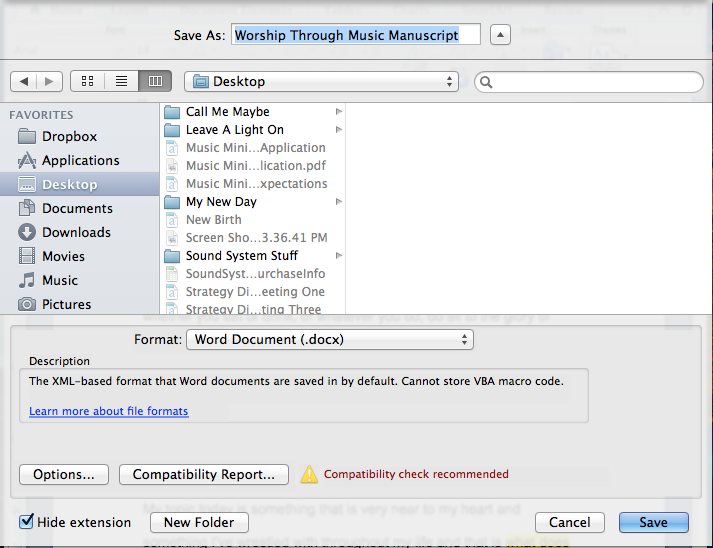
The first thing you need to do is actually write your sermon! I use Microsoft Word for all my typing. I’ve tried using Pages and NeoOffice and just found Word to be the easiest and most versatile. Once you’re done and ready to send it to the iPad you need to save it so you’d click File -> Save As

1That will take you to this screen:

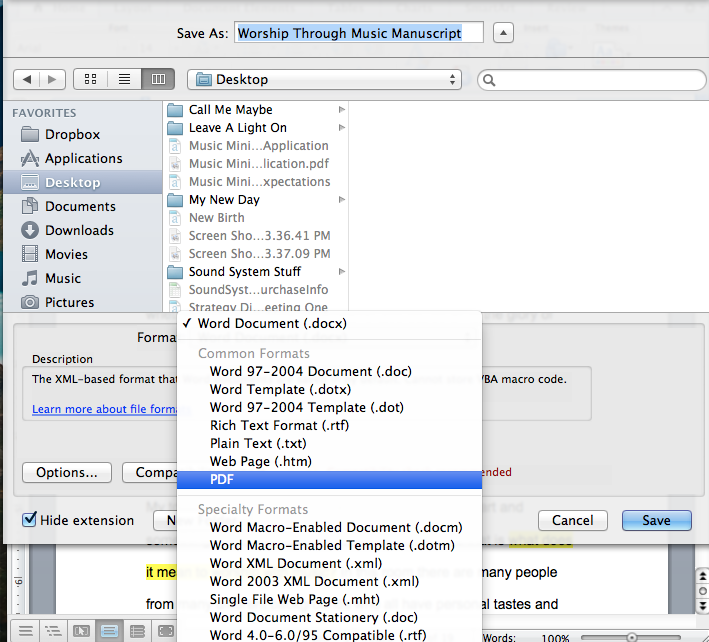
2

Name it whatever you want to name it, and make sure you save it to a place you can easily find. I always save it to my desktop. Then click in the Format box.

3Change the format to PDF, then click Save. Now is when it’s important to remember where you saved it! E-mail it to yourself as at attachment to the e-mail you can access on your iPad. I typically use this e-mail as a chance for some encouragement! Open the e-mail on your iPad and it should look like this:

4Click on the attachment to download the file, it will open in a new window like this:

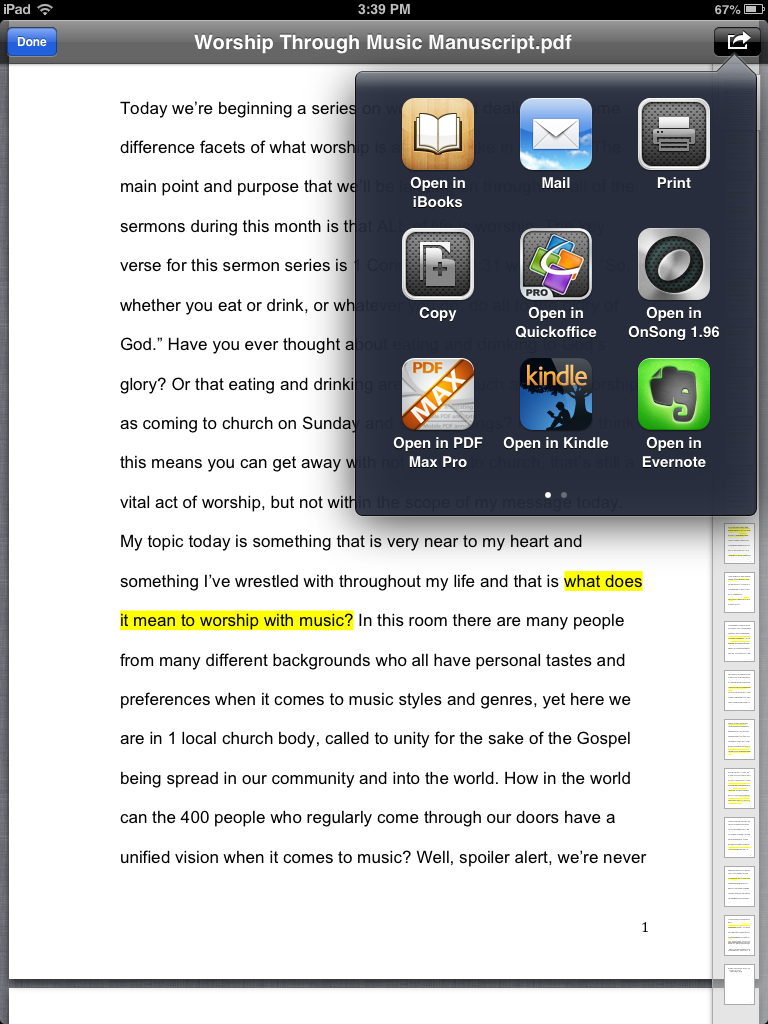
5Once you have that open, click the arrow in the top right corner which will give you a list of available apps to open the file with.

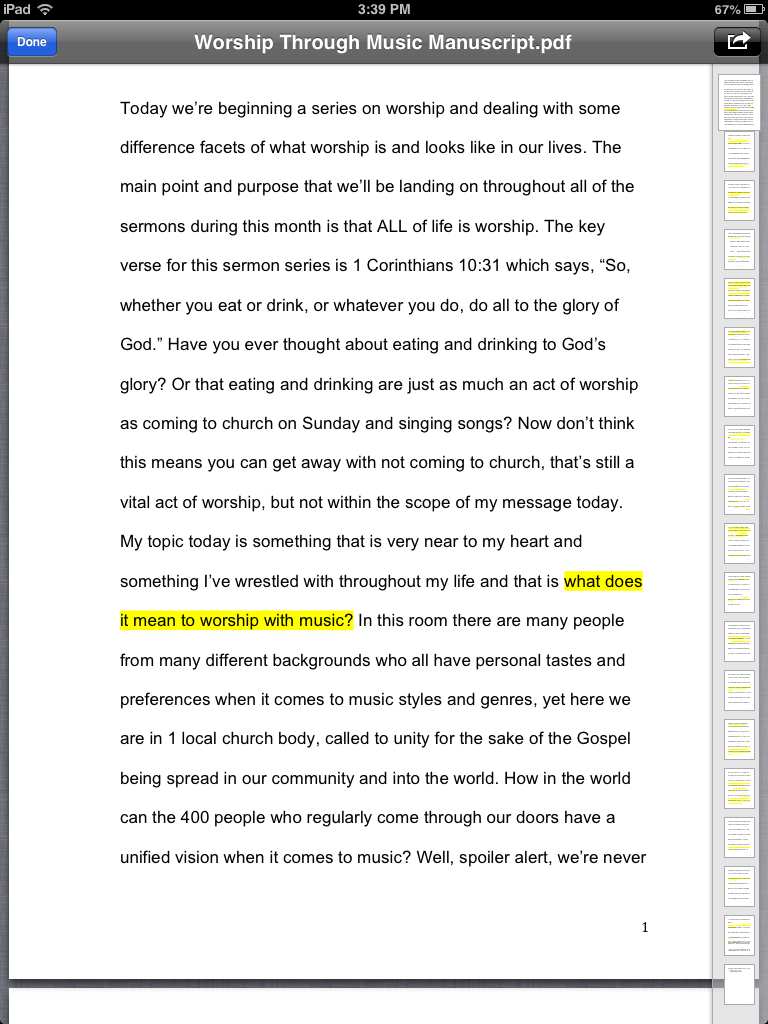
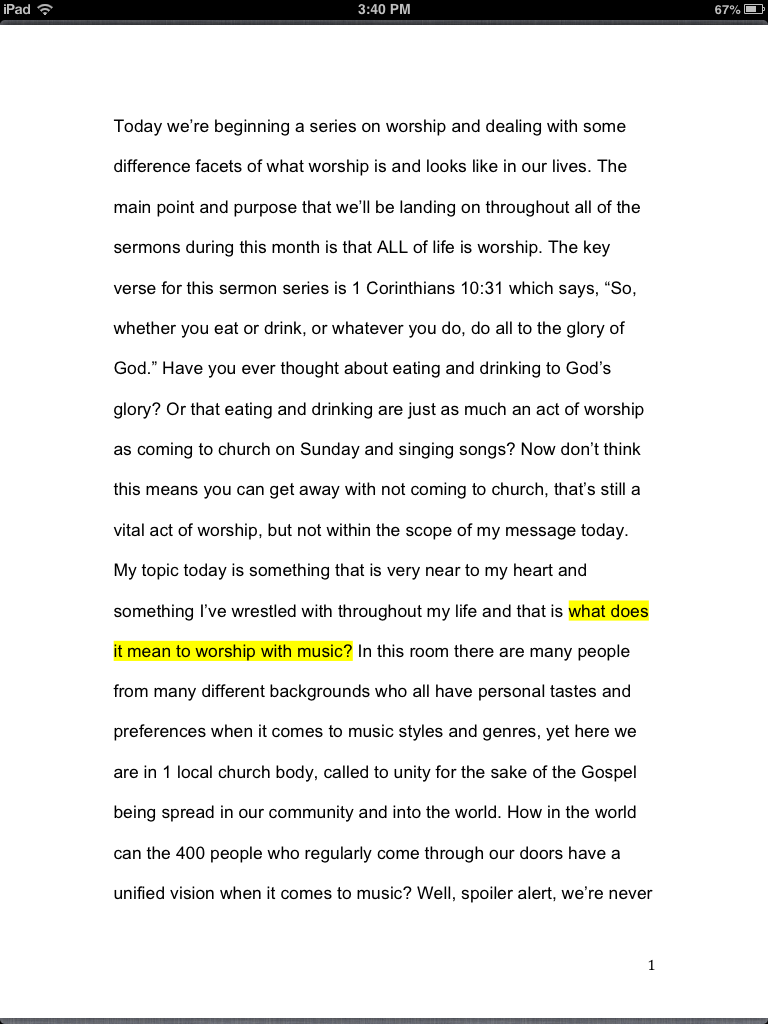
6Click ‘Open in iBooks’ and it may take a little bit to load depending on the size of your sermon, but you’ll finally have your sermon on your iPad looking like this:

7One of the best things about this is you can also see what time it is and how quickly you need to wrap up your sermon! A couple thing to remember about this is typically people have their display set to go to sleep after a couple minutes. I shut mine off for this. I also turned the brightness up all the way and made sure there weren’t any lights behind me that put a bad glare on the screen. I found this very easy to use and preach from without having to shuffle through what would have been 18 pages. My iPad has a smart cover on it too which has magnets in it so when I placed it on the music stand to preach from the smart cover held it in place really well. Feel free to ask me any questions about putting your sermons on your iPad!


Worship Through Music

I was given the opportunity to preach this past week and began a series on worship, looking specifically at worship through music. My main text was Ephesians 5:19-21 and ended with this point:

“This leads us to the final point from this Ephesians 5 passage “submitting to one another out of reverence for Christ” Brothers and sisters this continues to be one of the biggest issues in our church today. That first word, submit is something that is not attractive to our generation at all! Everyone wants to be in control of everything they do instead of being accountable to someone. We have convinced ourselves that we can be our own little gods who sit on our own little thrones and control our own destiny. Yet reading through Job we see just how small and insignificant we truly are. We come to church, not to encourage or support each other, but to get what we can from the church. We just looked at why we come together to sing corporate songs of worship together, it’s not for our sake, it’s for God’s sake!

One of the most disheartening things for me about where we are now is that before we sing every song I can look out at you and know who’s going to refuse to sing this specific song because it’s not one you like. Once again, I hate to be the bad guy, but it’s not about you. This is the very reason we had the “worship wars” during the past couple decades, too many have refused to submit to one another and have chosen instead to focus on themselves, their wants and their desires. Believe it or not there’s even some songs we do that I don’t like at all! Wait, you might say, you get to pick the songs. That’s exactly my point! Would you like it if every time we sang a song that I don’t really like I put down my guitar and refused to sing? Besides not keeping my job here very long, that would take the focus off of God and onto myself.”

You can listen to the message in its entirety here.