The God of the Garden (John 20) – Sermon Manuscript

-How many of you have seen the Marvel movies? I’m not a big comic book guy, but I still remember when Iron Man came out in theaters. I was in college, wanted to go see a movie, and figured I might as well see this one. It blew my mind! But what was even more amazing was that was just the beginning because they kept building on that movie. And at this point, I’ve given up on trying to see them all because some of them have been pretty bad. Marvel had a good streak, but after Avengers Endgame, I think they lost their way with the story a bit. AND I also feel bad for anyone that’s missed out on the last almost 20 years of Marvel movies, because in order to catch up you’ve got: 37 movies, 32 TV shows, with more coming out regularly!

-What’s most impressive about their run is that each movie tends to be a good story just by itself, but at this point, unless you’ve seen them all I can pretty much guarantee you’re going to miss some callbacks and allusions to previous things.

-That’s a picture of what we get in the Bible, but thankfully there’s no more books being added at this point, and unlike Marvel, the Bible never gets lost in its story. But in order to properly read and interpret the Bible, we need to know the story. The whole thing has allusions and references to previous parts of the story that if we’re unaware of will go right over our heads.

-I’ve titled this sermon ‘The God of the Garden’ because John’s account of the resurrection is FULL of allusions to Genesis, which means in order to understand the resurrection we need to understand creation. As we read through this text, see if you can catch all the allusions to the creation account:

READ/PRAY (pg. 963)

  1. The Garden Tomb (1-10)

-The story begins focusing on Mary, who came very early in the morning to the tomb.

-Where was this tomb located? This part of the story was read at our Good Friday service, it’s found at the end of the previous chapter:

John 19:41-42. The place where Jesus was crucified was in a garden. John is the only Gospel that has this note. John’s intentionally trying to call our minds back to THE garden in creation. And this garden theme has been building:

-If you look at John 18. I hadn’t noticed before that the text says Jesus OFTEN met there with his disciples. Jesus would take His disciples to a garden, a place where on His last night He prayed to His father asking for this cup to be taken away from Him.

-What’s so important about the place where Jesus was killed, as well as the tomb being in a garden? For that we need to think back to creation, because a garden is where sin entered the world, and John is telling us a garden is where sin met its end. But the garden isn’t the only piece John refers back to. This is why we need to know the WHOLE Bible, don’t just get stuck in 1 part of it, because if we don’t know the whole thing we’re going to miss all these ideas. We need to know the Bible so well our language and daydreams are impacted by it! That’s what we see from all the Bible authors (as I’ve been trying to point out through our 12 angry men series, even the minor prophets were quoting or alluding to so many other passages)

-Honestly, this whole thing as I was reading and studying this week blew my mind! So let’s think about the first garden, which I believe should be viewed as a temple. See, a temple is the place where God comes to meet with humans, and Eden was created as the place where God would come to meet with humans, we know that from Gen. 3:8. Apparently even God has preferences about what time of day is best, He would come walk in the garden in the evening.

-There are 3 components to the creation account that will align with the tabernacle and then the temple later: there’s the earth, the place where the humans dwell, there’s the visible heavens which is the sky above, and there’s the invisible heavens which is the place where God and the angels dwell, and the goal for God was to have no separation between all these things: He wanted His entire creation living and working and playing together. If you then think of the tabernacle, it is also built of 3 different components: the outer court (where humans can go), the Holy place (where some humans can go) and the Most Holy place (where God dwells). And woven into the fabric of the tabernacle and crafted out of gold in the temple are creation motifs, pictures of plants, animals, and angels in and on the walls. So Eden, the tabernacle (and later the temple) are meant to be representatives (stand-ins) for all of creation. God’s plan didn’t change, but the means by which His creation is able to access Him does.

-But there’s another sense piece to this that we can often miss as well. We often call it the Garden OF Eden, but a more precise word would be the Garden IN Eden, the garden was a subset of a bigger place called Eden, and the first humans were tasked with “working and watching” over the garden. Those 2 verbs are also used to describe the role of the priests in the tabernacle and temple, meaning that part of Adam’s role is to be the priest of this garden, who works and watches over it.

-And what’s most amazing to me about this whole process is the way God orchestrates is. In the days of creation 7 times it states, “and God said.” In the building of the tabernacle, it’s structured around 7 times where it states, “The Lord said.” And then when Solomon built the temple, it took 7 years, was dedicated in the 7th month, during a feast of 7 days, and Solomon’s speech is organized around 7 requests of God. All these things are meant to signify the resting place of God. Think of what God did on the 7th day of creation, so all these other acts are pointing to a similar goal: God being in relationship and proximity to His creation (although in the OT it has to be mediated, someone else has to be the go between).

-With all that background from the OT, look at how John begins the resurrection account. What day are we talking about? 

-The first day. As if this is meant to enact a NEW creation account.

-We also should be thinking of creation because of something Pilate (accidentally?) said about Jesus in the previous chapter. Pilate calls Jesus “the man,” which is the same thing God called Adam when he was cast out from the garden. The difference is in that place the judgment was just and right, this time, the judgment is laid on an innocent man. 

-For those of us who grew up in the church, we’ve heard this story so many times that we can miss what’s happening. How many of you would expect to find the body of a dead friend gone? People weren’t dumb in the 1st century, they knew what happened after someone died, they didn’t just get up and walk out of the grave!

-Which is why Mary’s response makes sense: someone took the body! What other option is there? 

-Peter and John (the one Jesus loved) take off immediately, most people think John got their first because he was younger (sorry to those of you who are older). John stopped, Peter went straight in, and what they found wouldn’t make sense if the body had been stolen: linen clothes, with one folded up and placed by itself.

-John is giving us 2 comparisons, 1 that’s immediate and 1 that’s much further back. First is a reference to a previous resurrection account in John’s Gospel where Jesus raises Lazarus from the grave. But Lazarus comes out fully wrapped in linen cloth, Jesus actually tells people to go help unwrap the cloth, he can’t do it by himself.

 -The second comparison is to the priests. Listen to what God commands Aaron to do when he meets with God during the day of atonement, the day where the sins of the people are paid for:    Then when Aaron is done atoning for the sins of the people, look at what he’s supposed to do with the linen cloth:

-By leaving His linen garments, Jesus is signifying that He was acting like Aaron in paying the penalty for the sins of the people. He’s saying that He has entered the Holy place, paid the penalty for the sins of the people, and gone back out. Friends, this is the reason the temple in the curtain was torn in 2! The Holy Place doesn’t need to be curtained off anymore; Jesus has provided a way for everyone to have access to God! 

-This section ends with an interplay between seeing and believing: John’s primary point of writing this story is so that we would believe (as you’ll see at the end!). Here John’s saying that seeing the empty tomb has resulted in a belief.

-But his belief isn’t complete: they did not yet understand what? The Scripture. There’s a reason Paul refers to the gospel message as a mystery, it was hidden, it wasn’t easy to understand! Until everything happened, the disciples didn’t get everything the Bible was saying.

  • The Gardener (11-18)

-This next section has some interesting references to Jesus that are supposed to (once again) remind us that this is a NEW creation.

-After Peter and John had left, John doesn’t tell us how much later this is, so either Mary came running back after them or was with them this whole time. But the text tells us that now Mary looks into the tomb. And there’s even some interesting verbs used to denote the historical reliability of this: it would have been carved into a hillside, where she would have to stoop down to see into the tomb.

-When she peeks in, she sees 2 angels, but why does John denote where they’re sitting? Because it points back to something else in the OT.

-When God gives instructions for building the Ark of the Covenant, on top of which was the mercy seat (where Aaron sprinkled blood while wearing his linen clothes). The mercy seat was called that because it’s the place where mercy was given to the people through the sacrifice of the animals. Where were the cherubim placed? The head and the feet. So God sending 2 angels to sit at both sides of where Jesus was buried is God’s way of saying there’s a new mercy seat, a new place where sins are atoned for! But that’s not all, does anyone know what was stationed at the garden in Eden when Adam and Eve were banished from it? Yep, the cherubim, the angels tasked with guarding the Holy of Holies. Once again, isn’t it amazing how God has woven these themes throughout this story? What once marked separation from God is used to mark that He is now near!

-And Mary’s story isn’t done: the angels ask her a question, this isn’t supposed to be a time for mourning, this is a time of rejoicing, to giving thanks, of dancing and praising God, because of what happens next:

-Jesus arrives, but she doesn’t know it’s Him. (there’s both similarities and differences between Jesus’s pre-resurrection and post-resurrection body, hold on to that thought because it will come up again in a minute). 

-Since she doesn’t recognize Him, who does she think Jesus is? A gardener. What were Adam and Eve tasked with being in the beginning? Gardeners. John is telling us that where Adam failed in his role, Jesus is faithful, and fulfills everything God wants for His creation. 

-Jesus says Mary’s name, and that’s all it takes for her to realize who it is, and she immediately comes running to Him! 

-Doesn’t Jesus’s response seem a bit harsh? Especially when just a few verses later He invites Thomas to come and touch Him. Most likely has a different connotation in both places, here she needs to be reminded to look forward further than the here and now, while Thomas needs the sight to believe. See Jesus is accommodating Himself to the needs of His disciples. No 2 people are the same, no 2 stories of salvation are the same. We’re given these different accounts so that we can understand the multiple ways Jesus draws us to Himself. And that thought continues through the rest of this chapter:

  • The Future Garden (19-31)

-What day does this begin with? John emphasizes what day it is AGAIN, he wants to make sure we understand a new creation motif is taking place!

-Why does Jesus say peace? This is the common Jewish greeting, one that’s still used today when they say “shalom aleichem.” But this is more significant than just peace be with you, this is meant to complement the last word He cried from the cross “It is finished.” Because Jesus said it is finished, there is now peace for His followers. And not just peace, both peace and reconciliation are now possible for humanity because of what Jesus has done. 

-Do you notice what Jesus shows them? His hands and his SIDE. Anyone who survived a crucifixion could show his hands and feet, but in order for them to know it was truly Him, He also showed the place where the spear pierced His side.

-Once again, He says peace to them, but then adds a component to this. Because they have peace with God, peace is now possible with other humans, so these first followers of Jesus are given a job: they are sent. Now, not in the same way as Jesus (because only Jesus can make atonement for sin) but they’re sent on the same mission as Jesus: to proclaim the good news that peace is now possible with God!

-This is the same mission we have today, and this is the reason we say at the end of our services: you are sent, because Jesus has sent us back into the world to represent Him and tell others about Him. It’s not meant to be a casual dismissal, it requires everything from us.

-But then John tells us Jesus does something weird, it says He breathed on them. Ever since COVID, this has made me chuckle, because people are so scared of being breathed on! I sometimes will blow in my kid’s faces, sometimes to have them check my breath! I don’t think that’s what Jesus is doing here. We need to keep thinking about the creation and new creation theme that John is focusing on. This same word that John uses to talk about what Jesus is doing is used in Gen. 2:7 when God breathes into Adam and gives him life. Do you see how Jesus is restoring all things here? I think Micky Klink summarizes what’s taking place here really well in his commentary: 

-Isn’t that an incredible summary of what Jesus enacted? While the OT is a story of humanity failing again and again, Jesus’s arrival means that God’s plan never got off track. He’s recommissioned this new people through this new creation to serve as kings and priests in the world. 

-Unfortunately, one of the disciples isn’t in this locked room with them, and it would stick with him for the rest of history, because people often refer to him as doubting Thomas! And there’s a sense where that’s right, but there’s another sense where I feel bad for him (especially considering I named one of my kids after him, because did you see what his name means in the text? Twin!) 

-Vs. 26 tells us the disciples did the same thing the next week, almost as if they expect Jesus to show up on this day, but this time Thomas wasn’t going to miss it. We’re already starting to see that there’s some new rhythms that are marking these people out, they’re meeting on the first day of the week, the day that Jesus rose from the grave. Friends, that means that EVERY Sunday is resurrection Sunday! This is literally the reason we’re here today! 

-Even though the doors were locked, Jesus comes to be with them. I said this earlier, but once again we see that there’s something different about Jesus’s body. He apparently can walk through walls or just appear at will. And he gives them the same greeting He did last time: peace.

-Then He singles out Thomas, but unlike Mary, Thomas is invited to come near and touch the Jesus’s wounds. And this confirmation leads to Jesus encouraging Thomas to believe. It’s a play on words in the original language: don’t unbelieve, believe!

-And Thomas responds with another component to the resurrection: while it has cosmic and eternal implications, it’s also personal. It’s for each one of us to believe that Jesus is not just the Lord, but He can be MY Lord. 

-And Jesus affirms Thomas’s belief, but He also affirms the belief of the rest of humanity throughout history: there’s going to be some people that don’t get to see His hands and side, but they can still believe, and there’s a special blessing Jesus gives towards people like that. Friends, this blessing that Jesus speaks here is for you and me.

-I was listening to some Rich Mullins this week (if you’ve never heard of him, you’re missing out! A Christian artist in the 80s-90s that died in a car accident in 1997). He had a line in his song ‘Step by Step’ that says “Sometimes I think of Abraham, how one star he saw had been lit for me.” God’s plans and promises are guaranteed to happen, nothing can stand against God, not Satan, not sin, and not death. And definitely not you and me. It’s incredible that God’s plans include a special blessing for us, we can be brought in to be a part of this new creation today! Which is what John says next:

-John concludes this chapter by giving his reason for writing this book: he could have included many more things that Jesus did, and in the next chapter 21:25 he actually says if everything Jesus did was written down, all the books in the world couldn’t contain it (which is why we’ll have eternity to think about it)! But this book was written so that even though we can’t see Jesus with our eyes, we can believe that He is who He said: the Messiah, the Savior, the Son of God, and through that belief we can have life, NEW life. Just like John has been casting the story of Jesus as a new creation, He’s telling us that we too can be a part of this new life creation, just like these first disciples. One of the amazing things about being a Christian, is if you think about it, everyone who becomes a Christian is only 1 generation away from those who saw the risen Christ. We’re reading these eyewitness accounts of people who saw Jesus in His resurrected body, we’re brought back to that very moment where Jesus invites His followers to believe in everything that He said. And that same offer is on the table for all of us today: don’t disbelieve, believe! The resurrection proves that God has followed through on all His promises, that His plans are good and right and true, and that through belief in Jesus we are able to have life, NEW life in His name. 

-If you haven’t yet made that confession, do it today. Jesus invites you to join with Him in restoring His creation. And if you have made that confession, Jesus also invites you to not be unbelieving but believe. Walking with Jesus is a lifelong pursuit where each day we’re invited to take one step closer to Jesus. That’s the invitation to new life that is available to all of us because Jesus is alive!

John 20:1-31 – Sermon Manuscript

-The resurrection is the single most important event for every single one of us to believe in. In fact, when I’m tempted to doubt, the empty grave is what I come back to every single time to remind me what’s really true.

-I can still remember the first time I dug into studying 1 Cor. 15,

-especially vs. 14 “If Christ has not been raised, then our preaching is in vain and your faith is in vain.” 19 “we are of all people most to be pitied”

-Some people have gone so far to say that if Jesus’ body was found it wouldn’t change anything about their “faith,” who’s to be pitied now?

-Which option is most likely, makes sense of all the evidence and therefore to be believed? Which book do we rely on as the most accurate representation of what happened in the 1st Century? 

-NT Wright

-Friends, the resurrection of Jesus is historically verifiable, it makes the most sense of the evidence given, and to just dismiss that claim is, as Wright say, to enter into a fantasy land! You have to find some way to account for the belief of the early apostles, the sudden growth of the early church, the change in approach by the disciples, and the way both Jews and Greeks responded to this news!

-We’ll see in John 20 – 4 different responses to the reality of the empty tomb, and as we’re looking at them, be thinking about which response you’re most prone to.

READ/PRAY (pg. 963)

  1. Peter and John (1-10)

-It’s fascinating that Mary Magdalene is the first person at the tomb.

-This is another piece that testifies to the reliability of the resurrection

-Women’s testimonies were viewed suspiciously in the 1st Century (no offense to the females in the room, but it’s a VERY different context than today!) this also served as one of the reasons Christianity was so attractive to the watching world – they honored people regardless of gender, ethnicity, creed, political leaning, sickness, they treated every person with dignity

-Other Gospel accounts share that Mary came with others to the tomb to add spices to Jesus’ body (way of honoring/respecting Him)

-But something unexpected happened as Marry arrived

-As she gets closer (it says it was still dark outside) she sees the stone is gone. 

-Maybe she is hallucinating, Luke 8 tells us she had demon possession in her past, is that still affecting her today?

-So she runs to get some other disciples to see if they see the same thing

-Quick note – “The other disciple, the one whom Jesus loved” is most likely referring to John, the son of Zebedee, who wrote this book. We have writings from the 2nd Century that list John as the author of this Gospel, 2 generations down (John – Polycarp – Irenaeus)

-John was so concerned with putting the focus on Jesus, he wouldn’t even list his name in the book he wrote about Jesus! We talked about this at our Maundy Thursday service, we’re supposed to have the same mind as Christ Jesus, always looking to others interest about our own, it’s why I have a tattoo to remind me that Jesus must increase, but I must decrease.

-Getting back to the story – she goes and tells Peter and John. Apparently grave robbing was a pretty serious offense in the 1st Century, so again, first instinct would be that’s what happened here.

-So they take off! Have a footrace to get to the tomb, John wins, scholars believe this is because he’s younger. Gets to the tomb and is so shocked he becomes paralyzed!

-If you’re a golf fan, I picture this a bit like Rory McIlroy last week when he sank his final putt, because remember who the author is here? John! John’s writing in Scripture that he won the footrace. Mic drop on Peter for eternity!

-But don’t worry, Peter’s hot on his tail! Impulsive Peter runs straight into the tomb. 

-Something weird about the burial clothes. You’d think if a grave robber came, they’d have just taken everything as quickly as possible, but Jesus’ clothes are still in there, almost as if not even clothing can constrain him anymore

-But notice a couple things about these clothes: linen clothes, and the piece on his head folded up.

-There’s some slight irony here, because Jesus was crucified naked, but John also tells us that when they took Jesus’ clothes off to crucify him, they didn’t tear his tunic. That word is used to describe the priestly clothes in Exodus and Leviticus, and it first appears in Gen. 3:21 as the clothing God uses to cover Adam and Eve’s nakedness. The fact that this tunic wasn’t torn is significant because priests weren’t allowed to serve God if their clothes were torn. Jesus, the perfect high priest fulfilled all of God’s laws, but he did it uncovered so that we today could be covered.

-Then John says the burial linens are carefully laid out. First this should make us think of last week where Lazarus needed help with his linens. That’s not the case for Jesus! This tells us the “swoon theory” (passed out but didn’t die) has no merit, Jesus was strong enough to take his linens off. But secondly, this points us back to the Day of Atonement. Aaron is commanded to take off his linens once the atoning sacrifice is done, he’s supposed to leave them behind as he goes back out. This is Jesus’s way of saying the atonement is done! The linens are left behind, just like the sacrifice for sin and death is now left behind.

-After Peter dives in, John follows (and another dig against Peter “who had reached the tomb first) and (as one commentator translated it) “Began to believe” but they hadn’t yet put all the pieces together.

-Maybe this is a good description of you today! You’ve started to believe in Jesus, but haven’t yet put all the pieces together on what it means to follow him. That’s fine! There’s a reason Jesus says your faith only needs to be as big as a mustard seed. 

-John then shifts from his focus from himself and Peter and moves on to the first person to witness the risen Lord

  • Jesus and Mary (11-18)

-She could have easily followed Peter & John back, then stuck around weeping, grieving.

-Not only had Jesus died, now his body had been stolen and there was nothing she could do about it

-Remember, they don’t have the same privilege looking back that we do! This is totally unexpected, neither Jews nor Greeks thought this was ever going to happen! But at some point Mary leans over again to look into the tomb, but it’s not empty anymore.

12 -The position of the angels is telling – Do you know of anywhere else in the Bible do we see an example of 2 angels sitting at both ends of something? Ex. 25 when God is giving his people instructions on how to build the ark of the covenant.

-Ark of the covenant is to be placed in the Most Holy place

-On top of the ark is to be built the mercy seat, and on both sides of the mercy seat were 2 angels engraved in gold.

-Significant because the mercy seat was where God would descend to meet with His people, where the priest would come 1/year into God’s presence

-These 2 angels are pointing to the reality that there’s now a new mercy seat that’s not dependent on the old sacrificial system. 

-But Mary doesn’t know that yet, so when the angels ask her why she’s so sad, she answers the only way she could know how – Jesus is gone, so she doesn’t know what to do.

-And Jesus is standing there and asks her a question.

-Could still be dark, could be the sun shining in Mary’s eyes, could be supernatural (there’s other instances of people spending time with Jesus and not recognizing him), but she thinks he’s the gardener who managed this area.

-Notice how Jesus responds. 1 simple word. He just says her name. But that’s all she needs. How do you respond when someone you love and care about calls your name? It’s not like being at church and hearing “Mommy” and watching 10 moms turn and look, this is more like when you’re growing up and in trouble and your dad calls you by your full name! You know exactly what’s going on!

-And that’s all it takes for Mary, her weeping turns to rejoicing! Her fears disappear, her tears of sadness turn to tears of joy as her Savior is standing right in front of her

-I don’t think it’s too much of a guess to think that she fell at his feet in worship

-But Jesus gently rebukes Mary, who’s trying to desperately cling to Him and not let go. She doesn’t want to lose him again. Jesus is communicating that something is different now than it was on before the resurrection, in fact, it’s something that he had promised previously, in John 16:7 “It is for your benefit that I go away.” His ministry is now shifting from ministering with his disciples to ministering through his disciples, but we’ll get there in a bit.

-Then Mary serves as the first witness to the resurrection and she tells the rest of the disciples this good news.

-Maybe you relate to Mary today! Maybe you feel like you’re trying to hold on to Jesus as tightly as you can, but you feel him slipping away. Even in the midst of her fears, she still is obedient to Jesus.

  • Jesus and the Disciples (19-25)

-The first 18 verse take place on Sunday morning, John then skips ahead a few hours to the evening.

-I would conjecture the disciples were wondering if the previous verses actually happened to them. Doesn’t our mind tend to play tricks on us like this? One of my favorite verses in the Gospels related to the resurrection is Luke 24:41. It shows the entire range of human emotions in the way the disciples respond. I don’t think the disciples really believed that Jesus rose from the dead.

-The reason I think they still weren’t convinced was because of the rest of this verse: they’re in a room with a locked door because they’re scared of the Jews

-It makes sense! The Jews just killed their Teacher, wouldn’t it make sense for them to take care of his followers too?

-Suddenly, Jesus joins them!

-Basically 2 Harry Potter options here: either Voldemort where the doors fly open, or he apparates straight into the room

-First words out of his mouth make it seem like he’s oblivious to what’s going on

-“Peace.” Really Jesus? You think it’s peaceful right now? His body was just beaten to a pulp, he was hung on a cross, and he’s focused on peace? This is such an important theme, he mentions it a second time in vs. 21.

-Wouldn’t it be nice if there were true & lasting peace in our world? Can you even begin to imagine what that would look like? Ukraine, China, Taiwan, Houthis, Sudan, Somalia. And what about different wars, like maybe a family conflict, conflict at work, or even internal conflict?

-Jesus came to make peace possible. Apart from him dealing with the sin of the world there’s no hope for lasting peace, lasting reconciliation, or even a smidgeon of hope that peace can come.

-Part of the reason He talks about peace is because He’s aiming straight for the hearts of the disciples, do you think they’re feeling like things are peaceful right now?

-Everything they’d been hoping in had broken, everything they’d banked on  disappeared, and then his body was gone! In the midst of all that chaos, Jesus

cuts through it all to bring peace.

-Then he goes for their heads and demonstrates that it’s really him, shows them his scars, this makes the disciples glad.

-Lastly they’re commissioned. Just as Jesus was sent by the Father, his disciples now need to carry on the exact same mission.

-This theme carries through vs. 22-23. There are some weird things in these next couple verses, so it helps to keep the idea that Jesus is sending his disciples out.

22 First weird thing, he breathes on them. What is Jesus doing here?

-Referencing back to 2 OT passages: Gen. 2:7, God breathes into Adam’s nose and brings him to life. Then Ezek. 37 where Ezekiel is brought to a valley of dry bones and told to prophesy over them, but they’re not alive until the breath of God is in them. Just as in the first creation God breathed into his creatures, in this new creation that Jesus is enacting through his sacrifice, so again God breathes into his people and makes them a new creation, filling them with the Holy Spirit.

-Then there’s another weird verse (23). What Jesus is doing here is getting back to His commissioning of His disciples. Jesus was tasked with bringing the kingdom of heaven down to earth, so now as His disciples share the gospel message in word and deed with the world, the response people give to this message will be as if Jesus was really there. The way God’s message goes out now is through his people, we today have the same authority as Jesus to preach the gospel, to tell the world how to have their sins forgiven.

-Unfortunately, 1 disciple misses this event:

  • Jesus and Thomas (26-29)

-Thomas has a normal response. Again, I think there’s a tendency today to miss the shock of the resurrection.

-“Doubting Thomas” doubtless would have thought he was the only one who was clear headed about this whole thing! Everyone else is losing their mind

-He needs to witness it with his own 2 eyes, otherwise he’ll never believe.

-Thankfully, Jesus is accommodating.

-A week later, the disciples are doing the same thing they had done when Jesus appeared the first time. Doors locked again.

-Again, Jesus joined them and began the exact same way, but this time Thomas was with them, and then invites Thomas to fulfill his wish. Then exhorts Thomas to believe instead of faithless. The Greek uses the same word with a negative; “don’t unbelieve, believe”

-Because Jesus himself shows up, Thomas then acknowledges that Jesus truly is God.

-Maybe you’re like Thomas, and you don’t actually believe the resurrection, and you think maybe you’d believe too if you’d seen Jesus come back to life. But did he really?

-This gets us to the last part of this chapter – this reality demands some kind of response.

-Jesus’ last statement in this chapter is a blessing to those who haven’t seen, but have believed. That’s any Christian today! Anyone here who has believed in Jesus did so without seeing him in the flesh. But someday we will see Him!

  • Jesus and You (30-31)

-John, the narrator, adds some commentary here, reminding us that not everything Jesus did is recorded in the Gospel stories. John was selective on which stories/signs he used, and the ones he picked were done to either urge you to believe, or if you already believe to encourage you to remain faithful, which will leave to eternal life, a life of peace.

-All of us today are called to be like one of these disciples in this story. Which one are you going to be like, how will you respond to the reality of the resurrection?

Holy Week Services

This past week was the celebration of Jesus’ death, burial and resurrection. This is one of those holidays that both Protestants and Romans Catholics celebrate together. I always look forward to this week and enjoy the opportunity to try some new things throughout the week. Last year we did our first ever Maundy Thursday service and continued that tradition this year. This year’s service was focused on the communal nature of our faith. I set up 12 tables in our sanctuary and had people gather sit around those tables. The service itself was divided up as following:

Greeting

What is Maundy Thursday? (John 15:12-17, Luke 22)

SING: Jesus Paid It All

Celebrate

The Passover (Exodus 12)

SING: In Christ Alone

Remember

SING: Mercy

The Lord’s Supper (1 Corinthians 11:23-26)

At each table was: Matzah, bitter herbs, hoaroset, and grape juice.

This was the longest time of the service, and each table had instructions to guide them through the various elements, as well as Scripture readings and explanations of what each element stood for.

Go

Love One Another (John 14:15-31, 1 John 4:7-21)

SING: Give Us Clean Hands

Each of the 4 parts also had a responsive reading and all 3 of the pastors on staff shared speaking responsibilities. Our time together was helpful in thinking through how the Passover applies to today, as well as being able to slow down and reflect more deeply about the Lord’s Supper.

On Friday night I divided the night into 5 parts and focused on the individualistic part of our faith. We are called into a community, but we are still still individually members of that community. Since February, we had been going through a series titled “Christ in the Psalms” so I carried that idea into our Good Friday service. It was divided into 5 sections with a Gospel passage being read aloud, followed by a Psalm displayed on the screen for people to pray through, and a station for people to participate in. As people were walking in there was a half sheet of paper with instructions, a nail and a pen to grab and take in to the service. It was divided as follows:

Remember

Luke 22:14-23

Psalm  105:1-11

Think back to when the cross and the Gospel message first began making sense to you. Write out that story in the space below, if there is not enough room, use the back of your paper.

SING: The Wonderful Cross

Betrayal

John 18:1-32

Psalm 55

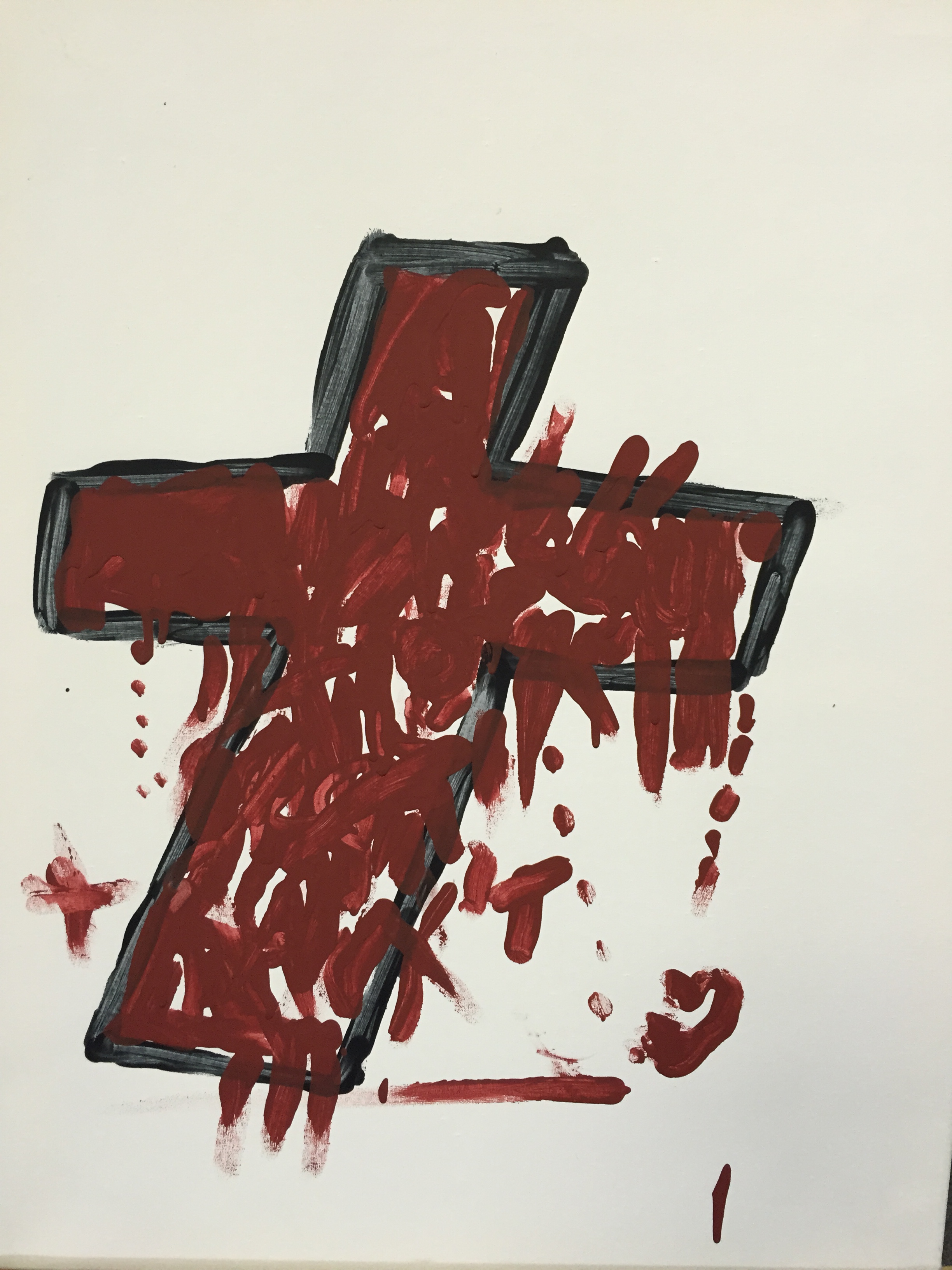
IMG_2814

On each side of the front of the sanctuary is a cross painted on a canvas, when you’ve had enough time to reflect, walk down the middle aisles to paint the canvas red. There are wipes for your fingers once you’re done. Please walk back to your seat on the farthest outside aisles.

Suffered

John 19:1-16a

Psalm 73

In the front middle of the sanctuary is a bucket for you to drop the nails you picked up when you entered. Whenever you have had enough time to reflect, please walk down the middle aisles and then return to your seat on the outside aisles.

SING: Were You There

Crucified

John 19:16b-30

Psalm 22

At the bottom of this paper is a space for you to write out why Jesus had to die for YOU. Write out as few or as many sins in that space as God lays on your heart.

It Is Finished

John 19:38-42

SING: Once Again

Psalm 25

On your way out the door, tear off the paper below where you wrote your sins and place them at the foot of the cross at the back of the sanctuary.

If you would like to “borrow” any of these ideas for your services, please do! They were enjoyable to plan and hopefully encouraging to the congregation.

What Is the Gospel?

What is the gospel? We’ve all heard the many different examples listed and been told that it is literally “Good New” to the world. The Good News that Jesus has come to take our place and pay the penalty for our sins, but what does that mean? (It’s even been asked in a book.) I think it’s even become the “hot topic” within Christianity today with more books and conferences than any of us can or should partake in. But that pat answer doesn’t seem to do it justice, and while I never want to minimize the importance of the gospel, I think many of us take it for granted.

  • It it exclusively about “Good News”?
  • Is there multiple ways to express the gospel?
  • Is the gospel just another name for the Bible?
  • Do we have a “hole” in our gospel?
  • Can it be summed up in 6 words?
  • Have we missed the heart of the gospel?
  • Have we made it all about morality and sexuality separated from grace?
  • Is it all of these things? None? Some?

Obviously I can’t deal with all the issues raised about in regard to the gospel, but I think as I’ve read what people have said and are saying about the gospel, we’re missing a huge piece of it. The piece that we’re remembering this week in the church calendar. The biggest piece missing from our discussion about the gospel is the cross. Apart from the cross, the gospel isn’t good news at all. In fact, if the cross is taken completely out of the discussion, the Bible just makes me want to curl up and die.

So many times I’ve heard the gospel message summed up as either a salvation message or a call to “fix” the world by bringing God’s kingdom to earth. And while Jesus did inaugurate a new kingdom, it hasn’t yet reached it’s conclusion. We live in a time period where Christ has ALREADY begun his work in redeeming the world but it has NOT YET reached its final point. There are a number of things that won’t be resolved until Christ comes again to “judge the living and the dead.” We need to learn to be content living within this unresolved tension until Christ returns. No, the gospel can’t be summed up in a list of moral codes or absolutes, but it can be summed up in the cross. The fact that God loved and loves us despite our sin. The fact that God sent His one and only son into the world and “tabernacled” or “made his dwelling” among us. The fact that God has now reconciled us to Him by taking our sins, past, present and future, upon Himself. The fact that He continues to relentlessly pursue us and woo us to Himself.

It doesn’t take me very long to daily be reminded of my sinful state. I’m continually attempting to find ways to build myself up, even if it means tearing others down. What hope could a sinful man like me have? Through the cross, infinite hope.

In his expose of the gospel message, Paul in 1 Corinthians 15 lays out the message of the gospel – but then shows us the hope we can have because the cross isn’t the final word – the resurrection is. In today’s culture it’s become commonplace to question the validity of Jesus. Was He really who He said He was? Did he really rise from the dead? Paul takes this to its logical conclusion when he says, “If Christ has not been raised, then our preaching is in vain and your faith is in vain.” Questioning the message of the gospel is in vain because we have it clearly laid out for us in Scripture. No, it can’t be put in a list because it’s how we should live.

BUT

Jesus did leave his disciples, and us, with this command:

Go therefore and make disciples of all nations, baptizing them in the name of the Father and of the Son and of the Holy Spirit, teaching them to observe all that I have commanded you.

I have yet to hear a sermon or read a blog that deals with this part of the great commission. Jesus told his disciples to observe all that He commanded. And Jesus laid out some pretty specific things. Honor your parents, love your neighbors, give to the poor and needy, and be perfect. How much of that list have you broken?

In one of my classes in college we attempted to condense the gospel to 140 characters to find out if we could tweet the gospel. I came to the conclusion that it can’t be done. In order to truly explain the message of the gospel I need to tell you about my life. Yes, the message of the gospel is that Christ has already done the work for us, but the implications for that have changed my entire life. Does your life paint a picture of the gospel, no matter how blurry or broken it is, or does it paint a picture of you? How has the gospel shaped your life today and where would you be without Christ’s work on the cross?

“Only let your manner of life be worthy of the gospel of Christ.”

Philippians 1:27

Lenten Reflections

Lent is something I’ve often heard of as I was growing up, but never really took a look at what it was or where it came from. Generally I just heard friends in high school who would give up things during Lent season, but didn’t have any idea that it was anything beyond that. Thanks to a recent post on the Gospel Coalition website, I learned a little more about what it is.

Lent (from the Latin for “fortieth”) begins on Ash Wednesday, 40 days before Easter. In a devotional guide to Lent, Kendal Haug and Will Walker say “Lent, therefore, is about living out of our union with, and identity in, Christ. Lent is first and foremost about the gospel making its way deeper into our lives.” What a great thing to celebrate and practice! Letting the Good News of the Gospel make its way deeper into our lives!

You can access this devotional guide through the Gospel Coalition blog or clicking here. I plan to go through these devotionals myself as I prepare for the celebration of the best news on earth: Jesus Christ dies for my sins, was buried, and on the third day he rose again, and now sits at the right hand of God, interceding on our behalf!