Psalm 39 – Sermon Manuscript

-Do you know anyone that never seems like they’re actually interested in talking to you? They always look just past you to see if there’s someone else they should be talking to so you end up feeling like an inconvenience. I know someone like that, and it frustrates me every time I talk to him! I’d rather he just tell me he’s busy than stand there and pretend to listen to me! At the other end of the spectrum I’ve met a number of people who are “Christian famous” who will remain completely engaged and focused on you no matter what’s going on around them. Met Matt Chandler once, and it really stood out to me!

-Which one of those responses do you view God’s way of engaging with you?

READ/PRAY

  1. Silent Suffering (1-3)

-Who is Jeduthun? Psalm 62, 77 – 1 Chron. 25:1

-Remember, these are written as the songbook for God’s people, just like we might make notes to Tami, Richie, or Micah

-David begins by contemplating how to be a happy person, which is the aim of this book! “How happy is the one who does not walk in the advice of the wicked or stand in the pathway with sinners or sit in the company of mockers! Instead, his delight is in the Lord’s instruction, and he meditates on it day and night.”

-How are we happy? By living the way God commands us to!

-He starts by pursuing holiness with his mouth, the way he speaks.

James 1:26. 3:6-10. Isn’t it fascinating the way James talks about the tongue? He says that the tongue is the marker of whether or not someone is “religious” (said in a positive way here, truly following after God). He goes on “no one can tame the tongue” no one. Out of the same mouth praises God, and belittles humans who are created in God’s image.

-Reflection on Jesus’ words in Luke 6 – the mouth reveals what’s really in your heart. 

-Maybe you’ve had this experience where something happens to you that you know isn’t good or right, and you overreact. Anger, frustration, flippant, and even in the middle of your poor response you tell yourself that you’re overreacting, but you can’t stop! 

-Swindoll “Life is 10% happens to you and 90% how you react to it.” Jesus talks about this reality earlier in Luke 6: If anyone hits you, turn the other cheek. If anyone takes your coat, give them your shirt. You can’t control what other people do, but you can control the way you respond, and that’s what God cares about. We’ll talk more about this idea later, but keep it in mind as we work our way through it.

-This is what David is meditating on in this Psalm. He doesn’t want to sin against God, but he’s seeing the wicked sinning and seemingly not suffering for it. He kept silent even when he wanted to speak good, so he got more and more frustrated at the lot of the world.

-Don’t expect the world to act like Christians, they’re not saved! But you will feel an inner turmoil about it, I know I do! It’s hard when it feels like Christians are being increasingly marginalized, when pastors are no longer trusted (read this week that trust in clergy fell to the lowest on record at 32%), when pastors fail at what feels like an alarming rate. Is there anyone actually following after God? What’s the point?

-We’re not the first people to feel that way! This is part of the reason the Bible remains relevant even 3,000 years after it was written – humans haven’t changed! We have the same desires, we still sin, and God is still God.

  • Short Shadows (4-6)

-Eventually, the tension builds up in David and he can’t help but talk, but just as last week he directed his focus in a specific direction, this week he does the same thing. 

-Look at the first word of this verse: Lord. Up to this point the pressure had been building in David, the frustration was increasing, but instead of blowing up at someone standing nearby, he aims his direction to the only one who can truly help him with his situation.

-Maybe you’ve been in a situation like this, where you were working your hardest to not respond in a mean way. Kids, maybe you’ve had that experience where your sibling just keeps pushing your buttons and they won’t stop! David is demonstrating for us here the right way to respond: go to God! Pray! Ask God to help you! God can handle your complaints, He knows all your emotions, and He’s promised to walk with you through every situation in life.

-But what David asks isn’t help in the present situation, it isn’t for God to destroy his enemies, this time he asks God to help David remember the end of his life.

-That’s a fascinating thought, isn’t it? All of us are mortal, we will someday die, and the older you get the shorter you realize your life is. Calvin turned 7 this past week, and I don’t feel like I’m old enough to have a 7-year-old! In my mind he’s still crawling in diapers! One of the things I’ve tried to do with my kids (imperfectly) is to not make them feel like they’re growing up too quickly, because of this reality. Calvin has lived 7 years, he should be a 7 year, regardless of how I feel, and if I just try to keep him stuck at where I feel like he should be both he and I miss out on the joy of our relationship today! This is what David’s expressing in theses verses. Our lives are nothing when you compare them to eternity. That’s why last week’s message is so important: endure in the midst of suffering and difficulty, because the end is coming! 

-There’s a sobering that comes when you reflect on your future, isn’t there? It shifts your focus, keeps today’s difficulties in perspective, and should bring joy to today’s experiences. I think this is where it’s so important to spend time with people older and younger than you. Older people help you remember that life is short (“just you wait, blink and they’ll be in high school”), younger people help you remember to take advantage of each day. Every day when my kids wake up they ask “what fun thing are we going to do today?” Every day is full of potential, if we are willing to be faithful with it!

-There’s a phrase that David uses here at the end of vs. 5 that is most often used in Ecclesiastes: vapor. It’s the Hebrew word hebel which has led to all sorts of debates about its’ meaning! It’s translated as breath, or emptiness, or vain, or futility. Some have translated it as fog.

-And David is comparing human life to that hebel, that vapor. Thankfully, winter hasn’t come yet, but during a cold winter day when you walk outside, what happens when you breathe out? You can see your breath! How long can you see your breath? A couple seconds? That’s how God sees human life, just like we see our breath.

-But this is only true of our earthly life. That’s what David means when he talks about being aware of our end! We need to factor eternity into our daily lives, and by keeping an eternal perspective, it will shift the way we engage our lives today. 

-There’s a missionary named CT Studd (1860-1930) served as a missionary in China, India, Africa who wrote a poem that has a refrain that is embedded in my mind: “only one life twill soon be past, only what’s done for Christ will last.”

-Selah. Contemplate the idea that your life is a vapor.

-David then continues contemplating the how short his life is, describing life as a “mere shadow,” where people rush around to get stuff, but they don’t know where they’ll end up. Have you ever considered that nothing you have will last forever?

-We see this in history, I think. Think of how we’ve discovered the Egyptian Pharaohs buried: with all their stuff, and sometimes even some of their slaves, which his incredibly morbid. But they didn’t believe this! They thought they were able to take all their possessions into the afterlife! 

-I read a couple stories this week about some of these realities that helped me to understand some of what David’s saying. The first was a man who looked at the average life expectancy for a male in the US and calculated how many days he had left. Each day he would knock a number off to remind him to “count his days.” Similarly, my dad’s dad died of a heart attack at 62. My dad and his brothers calculated the exact day, and when each of them turned that age they send a text out to the thread to give thanks for their good health. How do you number your days?

-The second story was about a man who lost his wife in his late 60s, but by God’s grace was able to meet another woman who had lost her husband about the same time. This man worked hard, but he wasn’t wealthy by any means! The woman he married, however, first husband was VERY wealthy! So this man who never had much suddenly had access to this other man’s wealth: friends you can’t take anything with you, even money! Only one life, twill soon be past, only what’s done for Christ will last.

  • Substance (7-13)

-Once again, David turns his attention to the Lord. He asks a question that’s true for all of us: What are we waiting for? 

-I think just as he’s been contemplating the realities of living in the world, here he’s continuing to ponder that idea. Another component of being human is waiting, isn’t it? You wait for food to be done, you wait in line at the grocery store, you wait at traffic lights, you wait for your kids to get ready, or you wait for your mom and dad to play with you! But then as you get older, you’re waiting for bigger things: you wait for your dream job, you wait for your dream car, you wait for the perfect house, you wait for a vacation, you wait for retirement. Yet each time you achieve what you were waiting for it changes, doesn’t it? That dream car doesn’t seem to be quite a dream when you have to take care of it, the dream job isn’t quite as dreamy as you had thought when you run into issues and conflict, and it’s not quite as fun or enjoyable as you thought it would be.

-What does David wait for? He says his hope is in the Lord, he’s hoping for God to be present to him. He’s asking God to be with him, to come alongside, to support him. If God is with him, it changes all the other waiting that we do on earth, doesn’t it? Suddenly all the other waiting starts to make sense because God is doing a work in us even as we wait. It shifts our perspective and mindset as we wait for the events on earth.

-But there’s a second component to this hope because David needs salvation from God. Another component to numbering our days is pursuing holiness instead of dabbling in our sin.

-We talked quite a bit about this in last week’s Psalm, but there are consequences to our sin, the question for us is what do we do with our sin? Do we continue to play with it assuming that it’s not that big of a deal, or do we confess our sins and bring them to the only person who has provided a way for our sin to be dealt with?

-When we keep our focus on eternity it begins to make our sins look really dumb. God doesn’t give us a list of rules as a punishment or as chains, God tells us how to live so that we can have life to the full! He wants us to live full, healthy lives in this world that He’s created, which means He knows best how we should live and desires that all of us can be in lasting relationship with Him.

-So friends, deal with your sin. Because your life is just a moment, keep short accounts. Because your life is just a vapor deal with your sin today.

-Selah. 

-The last place David goes is asking God to hear him because this world isn’t his home.

-I don’t know about you, but I love home (the place where your phone automatically connects to the Wi-Fi). I know where everything is (most of the time), I’ve got my earthly possessions there, I can grab food from the fridge whenever I want, it can become too easy at times to remember that this world isn’t actually my home. It can get too easy to get comfortable here and not count my days, not deal with my sin, not keep God as the focus of my life, which is why I need reminders like this Psalm. I need the reminder to keep an eternal perspective each day so that I don’t become complacent in my walk with God.

-As we wrap up, I want us to contemplate David’s direct requests to the Lord throughout this Psalm, there’s 3: (4) make me aware of my end, (7) what do I wait for, and (12) hear my prayer. 

-These 3 requests together are how we are able to keep eternity as the focus of our lives. The first is the reminder of our mortality. Because of sin, we will all die at some point. Because we will die, we should live differently today, which is what leads to the second request.

-We wait for the Lord! I think Paul gets at how we do this in Phil. 4:6-7. Because of what Jesus has done for us, we can live a worry-free life! That’s a whole lot easier to say than to live. But look at the outcome: the peace of God will guard your hearts and minds. Friends, lasting peace is possible, but only through Jesus, which gets us to the third one, and what Paul also mentions here:

-In everything, through prayer and petition, present your requests to God, or as David says “Hear my cry!” Bring everything to the Lord: your hopes, your sickness, your sin, your joys, He’s honestly the only one who’s patient enough to deal with it all! 

-Just as we saw last week with David’s reaction to being sick was to run to God, we see the same thing this week. We need to each day run to God because He cares for us, because He helps us to number our days, and because He’s the only one who can bring lasting peace to our lives. 

Psalm 32 – Sermon Manuscript

-Do you ever feel like someone’s always watching you? Security cameras everywhere (even in our building!), self-checkout you can watch them recording you!

-It would take 17 hours to read the terms and conditions for the top 13 apps in the UK

-I figure at this point that Google knows more about me than I do. And if that’s true of Google, how much more is it true of God? He created us, He knows us far more intimately than even Google does! So why do we so often pretend like we can keep things hidden from Him? 

-We’re going to talk to today about something that affects us all, something that has been true of almost every human being who has ever lived (1 exception, which we’ll get to), that is we are all sinners. EDoT: “Sin is not only an act of wrongdoing but also a state of alienation from God.” Rom. 3:23 “For all have sinned and fall short of the glory of God.” Anyone left out of that? Nope!

-But we don’t talk about it much today, and if we do we’ve somewhat sanitized this idea. We talk about messing up, a mistake, it was my bad, but we don’t often think about it how bad it is: cosmic treason against the Holy Creator God. I don’t say that lightly or carelessly, but because we have committed treason, all of us, we are worthy of eternal separation from God. 

-We talk a LOT today about God’s love, about His forgiveness, His mercy, and those are all right and good, but the only reason they’re good is because of just how terrible sin is, and I don’t think we give much thought to that anymore. We may have thought about it when we read ‘Sinners in the Hands of an Angry God’ in high school, or if we hear about someone REALLY messing up, but we don’t think about ourselves as sinners very often.

-Today’s passage gives us the reality that we’re all sinners, but it also tells us how to deal with that sin so it no longer affects us.

READ/PRAY

  1. Joyful Forgiveness (0-2)

-David wrote this, has some similar ideas to another Psalm he wrote – 51, after his sin with Bathsheba was uncovered. 

-Maskil – no one knows what that means, root word has to do with teaching or instruction, but that title is on a number of Psalms that don’t fit that.

-Joyful: happy, blessed. Begins the exact same way as the very first Psalm. Our minds should immediately jump back to that first Psalm, which gives us the theme of the whole book. If you want to be truly happy (not fleeting, like graduation which the gifts eventually break, or wedding day which is just 1 day, or getting a new car which eventually becomes an old car), it only comes through being obedient to God, by being a God-like person, responding as God would respond if He were you. Heavy job!

-Jesus talked about this too! One of his most famous sermons Matt. 5. Same word used here! Happy are the…

-Instead of rooting this joy/happiness in what we would think of blessing, David goes to sin. Does that feel like a sharp left turn to you? Maybe this should tell us something about the way we think about our sin! Instead of being flippant or careless to it (which has been an issue since at least the 1st cent.) Where Paul had to warn someone not to continue in sin to get more grace because that’s not the way it works! If we want blessing it comes by continuing to fight against the sin that we have within us.

-David uses 3 words to describe sin here, each one having a slightly different connotation and significance to them:

-Transgression – this gets to the idea of rebellion. Think of what we saw in Rev. 12 of Satan stirring a great rebellion against God. He tried to become god and let an entire revolt against him, but lost. If we don’t trust in Jesus we are a part of the rebellion. I think this is a part that is often missed today. We don’t start from a place of goodness, or even a place of neutrality when we look at God’s standard. All of us start in the same place: condemned as sinners.  I’ve had 5 kids now – it’s amazing how much we don’t need to teach them to be sinners! And it’s also amazing how much work it is to shape them to become upright people (I’d say it’s impossible until they’re saved!). 

         -This means that because we sin, God sees us in outright rebellion against Him. That’s why I’ll saw there’s only 2 options in your life! And we often only compare ourselves to other sinners, not to a completely perfect God, who is the standard we’re supposed to compare ourselves to. When we compare ourselves to perfect, who would dare to say they’re good enough? Think of one of the old proverbial phrases “to err is human” Being human means you will err, you will sin, you will transgress.

         -Think of it like this: could you get pulled over for going 1 mph over the speed limit? Technically, yes! That is breaking the law as it’s supposed to be the LIMIT for driving in that area, but we all know we’re not going to get pulled over. We tend to view God’s law the same way: technically it’s breaking the law, but God’s going to give grace to me, when in reality we’re just demonstrating that we’re more willing to rebel against Him than we would care to admit. 

-Sin – this one is picked up by a Greek word that means “missing the mark.” Often used in connection to archery. Think of your favorite local retail store: anyone know what store this is? Target. If you were aiming at the bullseye and you hit here, would that be successful?

         -Once again, so often we’re using the wrong standard of measurement when we think about sin. If we miss the mark, well that’s just human. Exactly! There’s an eternal chasm that separates the perfection God calls us to and the way we actually live. We all constantly and repeatedly miss the mark, no matter how hard we try we can’t ever reach it.

         -One of the best days of my life growing up was when I finally reached a mark. As I’ve shared, I love basketball, I’ve been playing basketball as long as I can remember, and there’s different goals you have as you grow. When I was in 7th grade I remember finally being able to touch the net. From there it’s grabbing the net and pulling yourself up, and then the backboard, and finally the rim. Rim is 10’, do you think it would be possible to ever touch it if it were 20’? Anthony Edwards can jump ridiculously high, but I don’t think even he could touch that net! What if it were in space? That’s where you start to get how far off the mark we are compared to God’s perfect standard. There’s literally no way for you to reach it.

-Iniquity – corrupted or twisted. This gets to the very motivation for us. Not only do we sin, but we still want to do sin! Think of what Paul says in Rom. 7“For I do not do the good that I want to do, but I practice the evil that I do not want to do.” We can’t help ourselves! We’re literally at war within ourselves for anyone who is in Christ. We fight against the sin within us, striving and straining against the sin, at least we’re supposed to be.

         -There’s a word that’s not used much anymore, but signifies what we’re supposed to be doing: mortifying sin, that is killing it. John Owen “be killing sin, or sin will be killing you.” (The Mortification of Sin). Friends, it’s much easier to just ignore it, or pretend sin isn’t an issue, but until Christ returns we’re going to continue needing to fight against sin, and until we actually start fighting and pushing back against sin, we won’t be blessed or happy. Remember, to err is human, but the quote goes on: to forgive divine. How does forgiveness come in?

-This is where we see 3 words that show us how God’s grace comes against even our sin, 1 for each of the ways we sin, did you see them as we were reading?

-Forgiven – pardoned from holding you accountable for your rebellion. Have you ever considered the power of forgiveness? Think of Les Miserables: Jean Vaujaun is forgiven for stealing silver and it literally changes the course of his life, that’s meant to be a picture of the what forgiveness does to us.

-Covered – when you miss the mark, God’s mark is counted instead of yours. Gets to the idea of the Passover (we’ve seen in Revelation the need to keep the Exodos story at the front of our minds). Anyone remember whiteout?

-Does not charge – take the biggest loan you’ve ever had (house, car, college) and imagine logging into your account and seeing the balance is $0, and you didn’t pay it. And all of this is rooted in who God is (grow in your theology!)

-Do you see what David’s saying here? The way to be happy is have all your sins dealt with once and for all, and that’s only possible because of who God is. He’s actually picking up on an idea from the Exodus:

-Some commentators believe David was reflecting on this passage because he uses the same language: Ex. 34 – forgiving iniquity, rebellion, and sin, same words! And look at how this passage describes God. Slow to anger, abounding in hesed. Compare His judgment to His love and forgiveness. The God of the OT isn’t all judgment and wrath!

-Paul quotes these verses in Rom. 4 to make the point that forgiveness from God is only possible if you have faith in Him, which begins an argument 2 chapters earlier where we see that God’s hesed is meant to lead to repentance. If we repent, we will be happy/blessed people, but what happens if we don’t? David goes on to list exactly what happens.

  • Sinful Desolation (3-5)

-Unlike someone who’s happy, because their sins are covered is someone who refuses to acknowledge that they’ve sinned. David could think on a time like that, and it literally affected his body!

-If you’ve ever had secret sin, have you ever felt this way? Like it physically was eating you up from the inside, and if people only knew what was actually going on inside they’d reject you? Remember: God knows everything, including what you think. You can’t hide from him, but many people do try to hide. What’s scary is if you become numb to sin and don’t have a reaction! That’s when you need to start worrying.

-Selah: I want you to take some time now to reflect and ask the Lord to reveal any sins that you need to confess.

-After having his body waste away from trying to hide, David confesses, and God forgives. John picks up this same idea in 1 John. We see this tension between still being sinners, but being able to be cleansed from our sins, and all it takes is confession. Doesn’t that seem too easy? On the one hand, I worry that we don’t take our sin seriously enough, but at the same time I also worry that we sometimes don’t confess because we feel like we need to pay some kind of penance or earn God’s forgiveness. This is why the message of the gospel is (or should be) so scandalous! It’s not based on what you or I have done, it’s based on what Jesus has done.

-I realize we just had one, but there’s another Selah in here for a reason! So take some time and think about the sins the Lord may have just brough to mind and confess them.

  • The Response of the Forgiven (6-11)

-Therefore: building on everything else said so far. Since forgiveness is possible, what should the response be?

-Instead of bottling it up and trying to hide, pray IMMEDIATELY to God and ask for forgiveness! When this happens, you suddenly go from being in rebellion against God to being able to withstand anything that comes your way. See: great floodwaters won’t hurt them (even a flood like Noah faced). God becomes our safe place. I onetime heard a story about the way we should think of God in relation to our sin, when a little kid gets into trouble is their instinct “Oh no, dad’s gonna kill me!” or “Oh no, I need to go find my dad!” Friends, because of what Jesus has done for us, our response should be the second one. When we sin, we run to God because His grace and mercy are enough for all our sins.

Selah

-Here we see what this could be viewed as instruction, we end with an exhortation from David. He contrasts following and being obedient to God with bring like a horse or mule who can’t do the right thing. Very similar to how Paul describes unbelievers in Rom. 1 as suppressing the truth and refusing the acknowledge the Creator God who rules over them.

-He goes on to say that many pains come to the wicked, but whoever trusts the Lord will be surrounded by faithful love.

-We don’t always see that around us. Doesn’t it often seem like the wicked are the ones who are doing well? That the one who cuts the most corners gets ahead, the one who cheats gets the raises and accolades, and Christians are increasingly marginalized? Psalm 73 talks about that exact idea! Asaph is complaining about how the wicked always prosper and do well while he’s wasting away, but then he gathers with God’s people and is reminded what’s truly true. Friends, God will bring about perfect and eternal judgment and justice someday, and when that day comes you can either have many pains, or faithful love: which one will you have?

-The last verse is a reminder for us to praise God for His forgiveness that is given to the 1000th generation! We can choose today to be forgiven, to be healed, to have our sin covered over, and to be finally and fully happy and blessed.

Psalm 31 – Sermon Manuscript

-Have you ever had one of those experiences where your response to a situation doesn’t match what’s happening? I remember most acutely feeling that during college. You leave for a year, then come back home and suddenly things at home feel weird. Siblings bother you in new ways, parents rules are overly restrictive all of a sudden, your best friends are acting weird (graduates, just wait a year, and I promise I won’t say I told you).

-As we grow as Christians, there will be times and seasons where our response doesn’t match the situation at hand. What do we do when that’s true? How do we snap out of it, and what would God have us do in the midst of those situations?

-I remember hearing someone onetime say the problem with people is they listen to themselves instead of preaching to themselves. If we feel discouraged doesn’t your inner voice make it worse? Or if you’re sad doesn’t your inner voice make you more sad? Or if you’re feeling guilty doesn’t your inner voice heap on even more guilt? Today’s text will demonstrate exactly what it means for us to take every thought captive for Christ – and it doesn’t come by faking it til you make it, or by reciting a verse out of context (God causes all things to work for good), but by being real with God.

READ/PRAY

-Housekeeping notes:

-Book of Psalms vs individual Psalm (please don’t get a tattoo PsalmS)

-Psalms were the songbook of God’s people throughout history, the songbook of Jesus, and gives words to the gamut of human emotion and experience. Luther called it a “mini Bible,” because it traces the whole storyline of Scripture, and points to realities of the incarnation of God’s Son. Athanasius “Whatever your particular need or trouble, from this same book you can select a form of words to fit it, so that you . . . learn the way to remedy your ill.” 

-These are used to help you know how to talk to God during every season of your life. I use that term season intentionally. I’ve found it helpful for myself to think of life in terms of seasons. Read The Resilient Life in seminary on this

-Every ministry job I’ve interviewed for has asked the question to my about balance in work and life. I don’t think there is. Wobble is better word.

-But God is still God in every season you’re in. “All of my life in every season you are still God.” (Desert Song). The Psalms are here to give us words in every season we’re in. Soak your mind in them, friends. 

-I know many people who read through this book each month, I’m doing a Bible reading plan this year that reads through it twice. Some orders of monks read through it every week.

-These are poetry, very different than prose, very different from apocalyptic. Read it full of flowery language, lots of extremes (very high highs and very low lows). Lots written by King David, all have musical notation, but none have the musical notes (intentionally).

-Last thing is the headings (verse 0) are a part of the original writings. Some give information about events that inspired the Psalm, some have musical notations, some tell the author. 

-Can be hard to preach, so keep that in mind! Because it’s poetry in order to get a cohesive outline we need to read it more section by section instead of verse by verse, so if I don’t touch on a verse you really liked or wanted to learn more about, I’m sorry! 

-Some notes about this Psalm: themes repeated in other places in the Bible. Psalm 71 copies the first 3 verse verbatim. Jesus quotes vs. 5 on the cross, Jonah quotes 6 from the belly of the fish, Jeremiah quotes vs. 136x. This one was apparently popular!

  1. God Is a Refuge (1-8)

-David begins by committing to seek refuge in God. 

-There are many times and places where David would be tempted to beg this of God. Chased by Saul, surrounded by enemies after he’s king, wayward children in his elder years who tried to take the kingdom away from him. There were many seasons in his life where he would need God to be a refuge.

-Disgrace means different things here than it would to us. Has a bigger and deeper meaning to them: social outcast, ghosted.

-If he’s been dismissed by everyone else, he starts to wonder if God will treat him the same way.

-Trusts himself to God’s righteousness. What does that mean? It means David is trusting himself in that God is right and will do right by His people. Since God is righteous, He can only be righteous to His children.

-Listen closely. One of the realities of being a parent today is the use of screens and how to handle them well with kids. I’ve had to learn how to be more present with my kids because they notice if I’m not actually engaged with them and distracted by my phone. This is David proverbially taking God’s face in his hands and saying “look at me!” That’s BOLD and takes courage, but is possible because he’s our Father.

-Interplay between 2-3. Asks God to be a rock of refuge, but it’s because God is a rock and fortress.

-James Montgomery Boice “’You are…then be…’ should be the prayer of every Christian.” Church, the reason we need to grow in theology is because it gives us a foundation to build the rest of our lives on. We could spend the rest of this sermon on this idea (actually the rest of our lives). Since God is faithful, we can ask Him to be faithful to us. Since God is love, we can ask Him to be loving to us. Since God is good, we can ask Him to be good to us. See, it’s only because of true things we know about Him (theology) that we can trust in Him throughout our lives. It’s only because we grow in theology that we can continue persevering in our faith and know that God will continue working in our lives. Theology isn’t just an intellectual pursuit, it’s a pursuit that is meant to help us better understand and trust Him. Keep that in mind as continue, I’ll come back to it.

-And notice how David continues: for your name’s sake. It’s not ultimately for us. 1 Cor. 6 your life is not your own, you were bought with a price. 

-David repeats this idea until vs. 6 where he contrasts himself with the wicked. I thought we were supposed to love everyone, including our enemies? Did Jesus just upend all this judging and hatred of the OT?

-Judge not? We’ve been reading some pretty dramatic ways Jesus responds to evil in Revelation lately. Does He just sit passively back and let evil run unchecked? No! Because God is the ultimate judge that provides a meaning even to our suffering today. On top of that, we even have a passage in the NT that tells us one of our jobs is to judge, but only a subset of people: the church. Friends, we must love each other enough to judge each other when we see sin grabbing a hold in someone’s life. 

-Idols were thought to bring healing and protection. Think more like a rabbits foot than a cosmic judge who sits on clouds. There were gods of each aspect of life. God of sea, god of rain, god of crops – needed to appease the right one based on the activity you were pursuing. 

-Where David lands this section is important. Instead of being handed to his enemy, God places him in a spacious place.

-Where would you rather go for a walk? Think of the freedom and joy that comes from a wide-open space to run and play. Think of Psalm 23 “He lets me lie down in green pastures.” Friends, this is God’s plan for your life! Wide open spaces. I remember growing up terrified that if I took 1 wrong step I would be outside God’s will and never get back on track. That’s not how God’s will works! He’s told us His will for all of us, and it leads to wide open spaces! You don’t have to be afraid of taking the wrong step, you don’t have to worry you’ll never get back on, this is the point of the overquoted passage in Rom. 8 that God causes all things to work together for the good of those who love Him. It means even when we take the wrong step, He’s still with us.

  • God Is Gracious (9-20)

-Things seem to take a sharp left turn for David here, almost as if he did step out of God’s plan for his life! He lists all sorts of issues: his body is failing him, he’s ridiculed, abandoned by his friends, ghosted, oppressed everywhere he looks. How do you respond in those situations?

-I remember when I was in high school reaching a point where God was starting to become more real to me. It felt like I was the only one following after God in the school, felt like I was the only one taking my faith seriously, and then my dad showed me 1 Kings 19: Elijah onetime felt the same way and God told Him (basically) get over yourself, you’re not as big of a deal as you think, I’ve got 7,000 others besides you. I learned that God works in community, not just individuals, so because God works in community, I can ask Him to give me community. God is always working to preserve His people! I can rely that I’m not alone and be encouraged to remain faithful. It is graduation season too – so high schoolers (and those who know a high schooler) remind them to remain faithful. It may feel like you’re the only one following God (even at a Christian college) so use this Psalm as a reminder to continue being faithful.

-Let’s look at how David responds, start in vs. 14

-Instead of focusing all his attention and energy on his peers, “friends” David looks to the Lord, and preaches to Himself in vs. 15. This is another reason I find the Psalms so helpful for us today: how often do we forget to preach to ourselves? How often do we succumb to listening to ourselves and then spiral worse and worse? Friends, this is part of the reason it’s so vital that we soak our minds in God’s Word. We need to have our minds shaped by what God says about us, not what we think or how we feel, because that changes minute by minute.

-Make your face shine is a way of denoting spending time in God’s presence. I’ve been kind of surprised how often that idea has come up in Revelation – the face shining connects back to Moses (Ex. 34) and also points to the transfiguration, which is then supposed to be reflected in believers today (2 Cor. 3:18).

-He goes on to contrast himself with the wicked (17-18), before going back to contrast them with those who fear (follow) God. He ends this section with something that we saw earlier that I told you to keep in mind. “God is….so be…” 

-God is good, therefore he asks God to be good to him, and everyone who fears him. Another reminder that we ask things of God because of who He is. Friends, God is good! And He is always working things out for us but it may not look like that while we’re on earth. Notice how it’s “stored up” Goodness is piled up in heaven just waiting for us!

-We’ve seen that through our time in Revelation: God continues protecting and preserving His people despite increasing persecution on earth. This is why we worship and praise God – because of His goodness (He IS good), because of His love (He IS love), because of His faithfulness (He IS faithful), even when it doesn’t feel that way. 

-This is another remind how important this gathering is in the lives of Christians. I don’t know about you, but I get discouraged during the week! I beat myself up, I doubt things about God that I know are true! But then I get to come in and have my selfishness shaken up each week! I get reminded that there’s something bigger than me, someone supporting me, and some people that He has called me to, which is the same place David ends:

  • God Is Faithful Love (21-24)

-It’s almost as if David has spent time in church! His outlook has been shifted, his desperation has changed and he realizes that God is on his side!

-The word he uses here is important hesed Sally Lloyd-Jones in The Jesus Storybook Bible “Never Stopping, Never Giving Up, Unbreaking, Always and Forever Love.” Because of all these truths about God, He always heard and always answers our prayers.

-We then see the need for us to live a certain way. Because God is faithful love, we can ask Him to be faithful in His love toward us, but we also need to respond by faithfully loving Him. If we do that then we can preach this last verse to ourselves and each other. We don’t need to fear, we don’t need to doubt, we can be strong, we can be courageous (bold!) because we know our outcome is as solid as the tomb is empty.

-End praying how this teaches us to pray. Spurgeon “We may pray to enjoy in experience what we grasp by faith. Faith is the foundation of prayer.”

-God is a refuge, so be a refuge

-God is faithful love, so be faithful love

-God is gracious, so be gracious

-God is good, so be good

Psalm 20 – Sermon Manuscript

-Both my parents grew up on a farm. There are a lot of things about it that sounded very enjoyable! Tons of room to run around, animals that are bigger than you to play with, farm equipment to drive around. I always liked going to the farm, they let me start driving as soon as I could reach the pedals! My dad’s side had 5 boys, so you can imagine that house. Interestingly enough, 4 of them have ended up in some kind of education role (the oldest still works on the family farm!). House of 5 boys who like to read & study. The older I get (and the older my dad & uncles get) the more stories get leaked out when they get together! 

-The youngest brother in particular had a bad habit during seeding of bringing books into the combine to not be so bored. As grandpa would drive around their acreage he would make comments about where each of the boys had gotten too invested in their book, or even note whole fields where books were being read! Do you know how he could tell? The plow lines weren’t straight! What was supposed to be a straight-lined field was covered with zig-zags. Each time my grandpa would apparently gently remind them to fix their eyes on a particular point in the horizon then never drift away from that spot, ensuring straight lines every time. But as boys are prone to do, there are far too many other things to focus on! A bird flying by, a rock in the pasture, contemplating when lunch is because they’re always hungry, or if it’s the Strand family the book you snuck onto the combine with you. 

-As Christians, we are all tempted to act like a Strand boy and be distracted by so many distractions around us instead of keeping our eyes focused and fixed on Jesus. Psalm 20 is a great reminder for us to be reminded to keep our eyes fixed on the right place so that our lives are marked by straight lines.

READ/PRAY

  1. God, Hear Our Prayers (1-5)

-A number of the Psalms we’ve studied together this summer as “royal Psalms” in that they are for/about/centered around the king. This one connects specifically to preparation for a battle.

-We miss some things as we don’t have a king, and are proud of it! I’ve been listening to the biographies of Alexander Hamilton and John Adams recently and was first of all struck with the differences in their approaches to life (Hamilton wasn’t a believer at least until the later end of his life, Adams was a committed believer), but secondly was struck by the strong debates related to whether positions of power should be passed down through generations, or whether it be merit based (if you didn’t know, merit based won out). 

-So since we don’t have a king, one thing we need to note is the king is meant to serve as the representative for the entire people. Our president is kind of similar to that, but not quite to the same extent. In the OT the king’s success determined the fate of the entire nation. Not too much of a stretch to say the nation was literally identified by the king, we can too easily dismiss identification with the president, even seen bumper stickers that say “don’t blame me, I didn’t vote for him”

-A second piece we need to be aware of as we read a royal Psalm is the king is meant to serve as the best, most accurate representation of God on earth. Remember last week we saw one of the first things a king of Israel was supposed to do was write out God’s law himself, then read and meditate on it throughout his life, allowing the king to keep his eyes on the right path and not end up with zig zags in his life! But because the king served as God’s representative, wars weren’t as we often see today for land or resources, wars were meant to reflect spiritual realities, so if a nation won in battle, it signified the superior strength of their God. 

-This is why the people would join together to pray for the protection and preservation of their king as they would prepare for battle. That’s why this Psalm begins by asking God to answer when the king faces trouble.

-“God of Jacob” shorthand for “God of Abraham, Isaac, and Jacob” connects all the way back to Gen. 22:17. (Abraham after the sacrifice of Isaac)

-This is another reminder, as we’ve seen before, to know the story you’re caught up in! David didn’t appear out of nowhere, there’s a history that he’s a part of. Whether you believe it or not, history has an ending point, but that also means there’s a purpose and a reason behind it. If we don’t know and understand the history and our place in it, we’ll miss where we’re aiming at. 

-“sanctuary/Zion” (2) similar to the shorthand above, refers to the place where God’s glory or manifest presences dwells. Same thing for us today praying “Our Father, who art in heaven.” Is he ONLY in heaven? Absolutely not! But it reminds us that He is not just like us.

-honor or accept the various offerings of the king. 2 different offerings mentioned in this verse (different Hebrew words to refer to different kinds of offerings)

-This isn’t (as I’ve heard far too many people say) putting God in your favor by offering, or tithing, or sacrificing something. These offerings refer to restoring the relationship between God and the king. 

-For example, the “burnt offering” refers to an atonement offering, as seen in Lev. 1. This specific offering is meant to deal with the sins the king has committed. There is nothing we can do to put God in our debt, yet as I talk to people there’s a tendency to treat God that way. “if I give this to God, he has to bless me back.” I even heard this from a pastor in town here! That’s not how God works!

-I liked the way one commentary put it: “it is the inward reality of right relationship that Yahweh remembers rather than the abundance of sacrifices offered. Rather than taking this to mean that God remembers how we make sacrifices (of time, money, suffering, etc.), this passage is talking about fulfilling our covenantal responsibilities of relationship to God. Have we acknowledged our sin and turned from it? Are we experiencing and celebrating a renewed and restored relationship with God? God “remembers” us when we are on the way of faithful loyalty to him and when we daily seek him with body, mind, soul, and spirit.”

Selah: instrumental to stop and reflect on what was just sung. I’ll leave the Psalm on the screen for you to reflect on it, think about your relationship with God.

-“heart’s desire” does this mean the king get everything he wants?

-Think about 1 instance in David’s life: when he first looked down at Bathsheba, was God’s answer to allow her to be David’s wife? Doesn’t this just confirm what I talked about in the last verse, if we make all these offerings, then God will give us the desires of your heart? Think of Cinderella “a dream is a wish your heart makes” or the song I danced to growing up “listen to your heart, when it’s calling to you.” So God is in heaven as our fairy godmother to make our dreams come true?

NIVAC: “this is a wake-up call to bring our hearts into alignment with the will and purposes of God.” Or this is a way of ensure our eyes are on the right place instead of being distracted by all the things around us.

-Notice what takes place right before this, acceptable sacrifices, not to place God in your debt, but working to align the king’s hearts with God. It’s only after being obedient to God that he’ll have the proper desires to ask for.

-This is the proper way to pray! ACTS, the Lord’s Prayer all reorient our hearts and minds before we get to asking.

5: do we actually celebrate that we have been saved? We should be a joyful people! Even celebrating communion like we did last week is meant to be a joyful experience because we’re no longer dead in our sin.

-As I was growing up I had no clue that Christianity was meant to lead to joy! Not sure where I missed it, but it always felt like being a Christian meant there was no fun, just joy sucking rules to follow. Yet when Jesus came, he was accused of partying too much! We shouldn’t be partying too much, but there should be a level of joy and celebration at the daily victory we have in Christ!

  • The Response of the King (6)

-Notice the change in pronouns here. We go from “you/your” to “I”

-God sometimes calls the equipped, but He always equips the called.

-There is no question or doubt “I know this truth!” this is one of the reasons it’s so important to continue meeting together, we sometimes need each other to believe the realities of the gospel.

-Tami at last week’s music practice warned the team: be careful where you look when we sing this song! It’s a hard one when you know what’s going on in people’s lives! But think of how encouraging it is to see someone struggling with a cancer seeing someone else struggling with cancer and singing their heart out because God is still working in them!

-David wrote this 1000 years before the birth of Jesus, we now have the privilege of seeing the fulfillment of this promise. God’s salvation is done, accomplished, finished, now there’s nothing that can separate you from the love of God in Christ Jesus our Lord!

  • The Response of the People (7-9)

-Literally: “some in chariots, some in horses, but we invoke the name of the one true God” What are you looking to as your ultimate source of identity, comfort, and strength?

Deut. 17:14-20 Last week we saw the need to write down the law, this week I want you to look at another command: not acquire too many horses, aka find comfort in your nation, your tribe, your people. Since God created us, he knows our tendencies to look to anything else as the source of our confidence instead of Him, which is why we have vs. 7 in this Psalm. Specifically, what this is referring to the ancient near east is putting your ultimate confidence in geo-political power. The chariots/horses were the best weapon of the day, whoever had the most would most likely win in a battle. Has anything changed since?

-I say this with some trepidation, knowing that it may step on some people’s toes, but why is it that so many people today are looking to Politics as their primary source of identity? Why is everything that’s said filtered through a partisan lens instead of filtering it through a Jesus lens? We see this every 4 years from both sides! (actually seeing it pretty much daily now) Unless our candidate is elected into office our country is going to descend into anarchy, or if our candidate isn’t in office our country is falling apart and it’s OBVIOUSLY the fault of the policies of the other side. Unless this vote passes through the House our world is going to fall apart. It’s using fear and scare tactics to manipulate people, and the sad part is that it works! So then in response to the fear from one side, the other side doubles down on the opposite position and leaves no room for nuance. I wonder if today this verse would be more applicable if it said “some trust in the donkey, and some in the elephant.” 

-Neither party is completely aligned with every Christian virtue, which makes it hard to know how to vote. The problem in our culture today is because everything is viewed through a partisan political lens far too many assumptions are made about what someone truly thinks or believes. Instead of asking for clarification or trying to understand where someone is coming from, conclusions and assumptions are made about whether someone is “in” or “out” and then we decide if we’ll continue associating with them or not. This is the mark of following the ways of the world, not the ways of our Lord, and this cuts through both sides of the political aisle.

-This doesn’t mean we therefore throw up our hands and disengage (as tempting as that might be!), instead I think we need to work hard to find a better way forward together, and it MUST start in the church. 

-This is why I have said and will say in the future, leave your politics at the door when you come in here. What I mean by that (and what I should probably change what I say to) is leave your PARTISAN politics at the door, because there are political truths that must be shared in here: Jesus is Lord is a political statement, because it’s saying no one else has the ultimate answers or authority. The Bible makes it clear that every person who is in authority (kings, rulers, presidents, governors) is in there by God’s good plan and design, even ones you don’t like or agree with.

-I have read of, and even talked to, some pastors who have shared Bible verses over the past few years and then either been labeled a woke Marxist or a racist, and I know they were neither of those things! Why is it that sharing something like “blessed are the peacemakers” or “turn the other cheek” or “a gentle answer turns away wrath” are labeled “woke” today? If you didn’t know, I just quoted Matt. 5:9Matt 5:39, and Prov. 15:1. I’ve been called some of those things since I got here! When everything is filtered through a partisan political lens there’s no room for nuance, subtly, or trying to understand someone else’s point of view. Yet that’s exactly what we as Christians are called to do.

-I’m not sure how this happened (I’m still trying to wrap my brain around it) but there has even been Christians I know who have said it’s time to move on from gentleness and start fighting fire with fire. 

-I need all of you to pay attention to this: demonstrating the fruit of the Spirit isn’t optional for anyone who is “In Christ.” Look at these 2 lists Paul gives us in Galatians 5: one of them is led by the Spirit, and one of them is not.

-Maybe politics isn’t important to you at all! You’re probably much more sane than many of the people you’re rubbing shoulder with! However, these 2 lists I think can serve as a litmus test of where you have idols in your heart that God is revealing to you. In what areas of your life are you marked by the flesh instead of the Spirit? When are you prone to respond with sexual immorality, etc. instead of love, etc. In God’s kindness, He is provided a way for you to see where you’re looking to comfort in the world instead of Him. Areas in your life where you’ve taken your eyes off the right place and turned them to worldly things.

-Vs. 8 doubles down on this idea: Those who trust in anything other than God collapse and fall.

-We’ve seen this all summer! Where is the foundation of your life, in rock or sand? Do you have enough foundation built to endure the difficulties of life, or are you building on a foundation from this world that will ensure destruction? 

-Do you want to have God answer your prayers? Entrust yourself to God. Do you want to have a flourishing life? Entrust yourself to God. Do you want to have the strength to endure under trials? Entrust yourself to God. Do you want to be a strong person who isn’t worried by the changing world around us? Entrust yourself to God. 

-The last verse is repeated in the NT. 1 Tim. 2:1-2 also commanded to pray this in the NT. Do you pray for “kings and all who are in high positions”? Once again, not just for the candidates whose policies you agree with, but for “all people.” 

-Similarly to many other Psalms, all this is pointing us to the ultimate and perfect king: Jesus. Today we can use this prayer when we remember that we are in a battle, not against flesh and blood, which means we can’t use the world’s weapons to fight!

-Don’t lower yourself to slander, dissensions, or divisions. That’s how the world will try to tempt us to fight! Instead we fight by demonstrating: love, joy, peace, etc. And who demonstrated those traits perfectly? Jesus! Therefore, as we saw at the beginning of this, we need to keep our eyes fixed on Jesus. Don’t be distracted by the things of this world, don’t let your eyes wander away from Him. It’s only by faithfully keeping your eyes on Him that the lines of our lives will be straight.

Bene: (Heb. 12:1-2)

Therefore, since we also have such a large cloud of witnesses surrounding us, let us lay aside every hindrance and the sin that so easily ensnares us. Let us run with endurance the race that lies before us, keeping our eyes on Jesus, the pioneer and perfecter of our faith. For the joy that lay before him, he endured the cross, despising the shame, and sat down at the right hand of the throne of God.

Holy Week Services

This past week was the celebration of Jesus’ death, burial and resurrection. This is one of those holidays that both Protestants and Romans Catholics celebrate together. I always look forward to this week and enjoy the opportunity to try some new things throughout the week. Last year we did our first ever Maundy Thursday service and continued that tradition this year. This year’s service was focused on the communal nature of our faith. I set up 12 tables in our sanctuary and had people gather sit around those tables. The service itself was divided up as following:

Greeting

What is Maundy Thursday? (John 15:12-17, Luke 22)

SING: Jesus Paid It All

Celebrate

The Passover (Exodus 12)

SING: In Christ Alone

Remember

SING: Mercy

The Lord’s Supper (1 Corinthians 11:23-26)

At each table was: Matzah, bitter herbs, hoaroset, and grape juice.

This was the longest time of the service, and each table had instructions to guide them through the various elements, as well as Scripture readings and explanations of what each element stood for.

Go

Love One Another (John 14:15-31, 1 John 4:7-21)

SING: Give Us Clean Hands

Each of the 4 parts also had a responsive reading and all 3 of the pastors on staff shared speaking responsibilities. Our time together was helpful in thinking through how the Passover applies to today, as well as being able to slow down and reflect more deeply about the Lord’s Supper.

On Friday night I divided the night into 5 parts and focused on the individualistic part of our faith. We are called into a community, but we are still still individually members of that community. Since February, we had been going through a series titled “Christ in the Psalms” so I carried that idea into our Good Friday service. It was divided into 5 sections with a Gospel passage being read aloud, followed by a Psalm displayed on the screen for people to pray through, and a station for people to participate in. As people were walking in there was a half sheet of paper with instructions, a nail and a pen to grab and take in to the service. It was divided as follows:

Remember

Luke 22:14-23

Psalm  105:1-11

Think back to when the cross and the Gospel message first began making sense to you. Write out that story in the space below, if there is not enough room, use the back of your paper.

SING: The Wonderful Cross

Betrayal

John 18:1-32

Psalm 55

IMG_2814

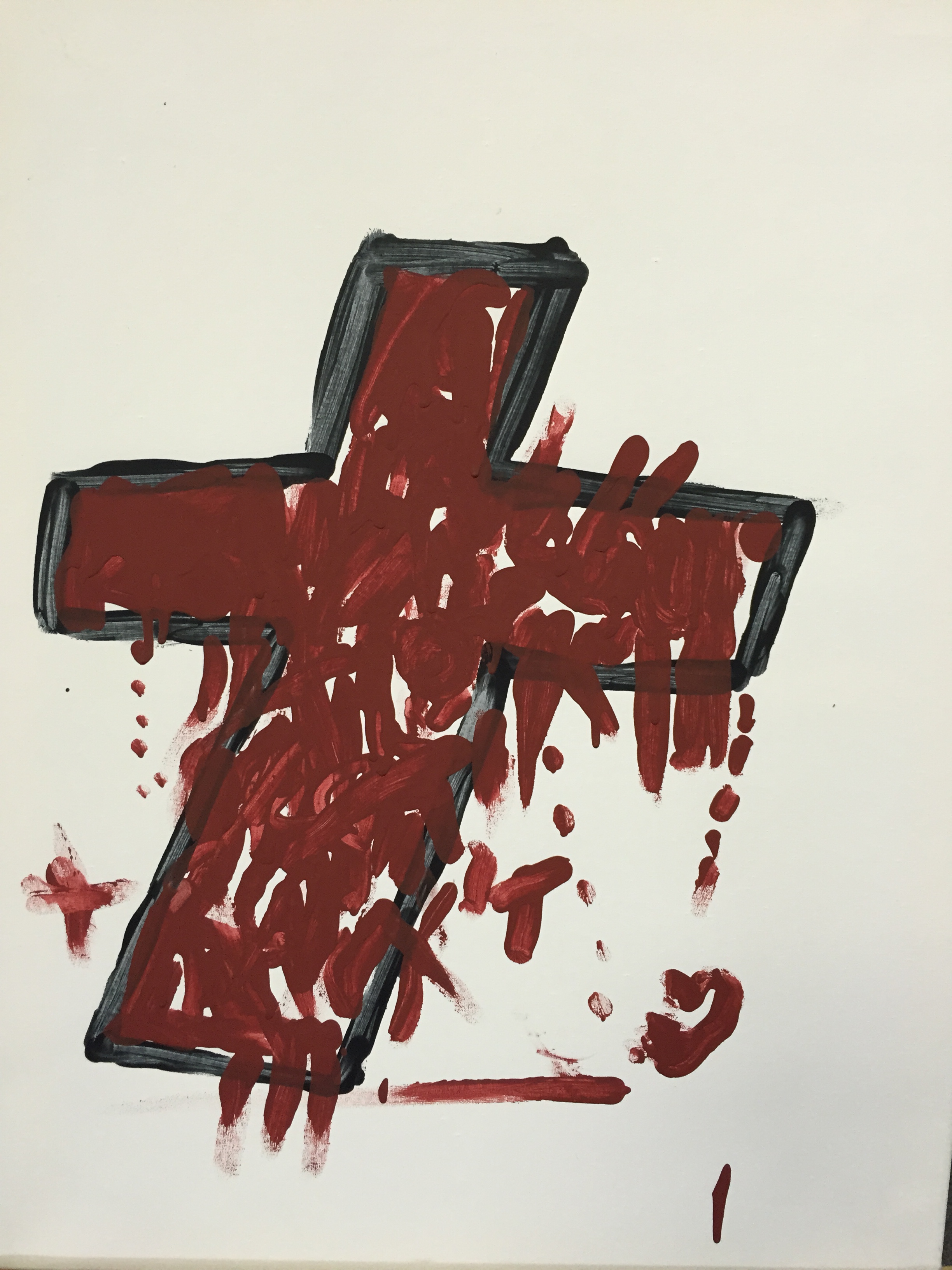
On each side of the front of the sanctuary is a cross painted on a canvas, when you’ve had enough time to reflect, walk down the middle aisles to paint the canvas red. There are wipes for your fingers once you’re done. Please walk back to your seat on the farthest outside aisles.

Suffered

John 19:1-16a

Psalm 73

In the front middle of the sanctuary is a bucket for you to drop the nails you picked up when you entered. Whenever you have had enough time to reflect, please walk down the middle aisles and then return to your seat on the outside aisles.

SING: Were You There

Crucified

John 19:16b-30

Psalm 22

At the bottom of this paper is a space for you to write out why Jesus had to die for YOU. Write out as few or as many sins in that space as God lays on your heart.

It Is Finished

John 19:38-42

SING: Once Again

Psalm 25

On your way out the door, tear off the paper below where you wrote your sins and place them at the foot of the cross at the back of the sanctuary.

If you would like to “borrow” any of these ideas for your services, please do! They were enjoyable to plan and hopefully encouraging to the congregation.